Retaining Wall Requirements for Sloped Amherst Yards
Managing a sloped yard can feel like a constant battle against gravity. Every heavy downpour washes away valuable topsoil, while steep inclines render large portions of your property completely unusable for outdoor living, gardening, or recreation.
A professionally engineered retaining wall is the ultimate solution to reclaim your land. By holding back tonnes of shifting earth, these structures convert unusable slopes into clean, terraced levels. However, building a wall on a slope requires a careful blend of engineering principles, local zoning compliance, and strict adherence to structural requirements.
1. Structural Requirements & Height Thresholds
The absolute first rule of planning an earth-retaining structure on a slope is understanding when a simple landscape feature crosses the line into a heavy civil engineering project.
The Four-Foot Rule
In most municipalities across Western New York, including the Town of Amherst, any retaining wall that stands 4 feet or higher (measured from the bottom of the buried footing to the absolute top of the wall) requires a building permit.
- Under 4 Feet: These are generally considered landscape walls. While they still require proper structural planning, they typically do not require formal building permits or certified engineering stamps, provided they are not supporting an extra load.
- 4 Feet and Above: These are structural retaining walls. The immense lateral earth pressure behind a wall of this size can easily cause a catastrophic blowout if it is under-engineered.
Understanding Surcharge Loads
A “surcharge” is any extra weight placed on the soil behind or above the retaining wall. Even if your planned wall is only 3 feet tall, you will likely still be required to obtain a building permit and structural engineering blueprints if the wall supports the following:
- A driveway, parking pad, or sidewalk.
- An upward slope that continues rising steeply above the top of the wall.
- A nearby accessory structure, such as a shed, deck footings, or a home foundation.
Frequently Asked Question
Do I need an engineer for a 3-foot retaining wall in Amherst?
Generally, no. The Town of Amherst does not require an engineering stamp or a building permit for walls under 4 feet. However, if your 3-foot wall is built on a steep slope where the hill continues upward behind the wall, or if it sits within 3 feet of a driveway or structure, it creates a “surcharge load”. In those specific cases, a permit and professional structural planning are required regardless of height.
2. Navigating Amherst Building Codes and Permits
Before a single shovel touches the dirt, you must verify compliance with local dimensional regulations. Building without a permit or violating setbacks can result in severe municipal fines, stop-work orders, or a legal mandate to tear down the entire structure at your own expense.
Setback and Property Line Regulations
Per Amherst town ordinances, hardscape structures and walls cannot simply be placed anywhere you please.
- Front Yard Restrictions: Retaining walls over 3 feet in height generally cannot extend directly into the front yard setback of a residential district unless deemed structurally necessary by the Commissioner of Building.
- Clear Vision Triangles: If your sloped yard is located on a corner lot, your wall must not violate the “clear vision triangle”. This means no structure can stand higher than 2 feet above the average finished grade within 35 feet of an intersection right-of-way, ensuring that vehicular and pedestrian sightlines remain completely unobstructed.
- Property Line Proximity: Walls must be built entirely within your private property boundaries. It is highly recommended to order a professional property survey before finalizing your design to ensure you do not inadvertently encroach on municipal land or your neighbor’s property.
Frequently Asked Question
How close to my neighbor’s property line can I build a retaining wall in Amherst?
While minor landscape borders can technically sit close to a property boundary, structural retaining walls requiring excavation must respect local setbacks and structural zones. Excavating a slope right up to a property line can destabilize your neighbor’s soil. A safe rule of thumb is to set the wall back a distance equal to or greater than the height of the wall to allow for safe excavation, proper gravel backfilling, and geogrid reinforcement installation without crossing the property line.
3. The Crucial Role of Foundation and Soil Mechanics
A retaining wall on a sloped yard is only as stable as the soil beneath it and the foundation supporting it.
Dealing with Amherst Soils
The soil profile in our region often transitions from loose topsoil to dense, poorly draining silty clays. Clay soil is notorious for holding water, expanding when wet, and exerting tremendous hydrostatic pressure against the back of a wall. When building on a slope, the foundation must be excavated deep into undisturbed, solid subsoil—never on loose, uncompacted fill dirt.
Frost Depth and Embedded Footings
Western New York winters are notoriously harsh, and the freeze-thaw cycle can wreak havoc on masonry. When water in the soil freezes, it expands, causing a phenomenon known as “frost heave” that can push a poorly anchored wall clean off its axis.
- Base Trench Depth: The bottom row of your retaining wall blocks or stones (the footer course) must be completely buried underground. As a standard baseline, for every 8 inches of wall height, at least 1 inch of block should be embedded below the finished grade.
- The Aggregated Base: The wall must sit on a compacted, levelling pad of crushed angular stone (usually 4 to 6 inches thick). This gravel base distributes the weight evenly and prevents the wall from settling or tilting forward into the downward slope over time.
Frequently Asked Question
How deep should a retaining wall foundation be in Western New York?
Your foundation trench depth depends on the total height of the wall and the slope severity. For a standard 4-foot wall, you need a minimum of 6 inches of compacted crushed stone base, plus at least 6 inches of the first block course completely buried underground (embedded) to resist frontal soil shifting and frost movement. For massive engineered walls, foundations must extend deeper to anchoring points below the local frost line.
4. Managing Water: Advanced Drainage Solutions
Water is the number one enemy of any retaining wall. When it rains heavily, water flows down your yard’s slope and pools directly behind the wall structure. If that water has nowhere to go, the resulting hydrostatic pressure will eventually cause the wall to bow, crack, or completely collapse. Integrating a complete yard drainage and landscape design strategy prevents water from pooling at the base of your investments.
To ensure structural longevity, your design must integrate these three vital drainage elements:
| Drainage Component | Purpose / Specification | Why It Matters on a Slope |
| Gravel Backfill | A 12-inch wide column of clean, angular crushed stone directly behind the wall blocks. | Allows water trickling down the slope to instantly drop to the base of the wall rather than pressing against the masonry. |
| Perforated Drain Tile | A 4-inch perforated PVC pipe laid at the very bottom of the gravel backfill trench. | Collects the descending water and funnels it safely out away from the sides or through the face of the wall. |
| Weep Holes | Small openings placed along the bottom course of the wall blocks. | Relieves immediate water pressure by allowing trapped moisture to escape out the front of the structure. |
Frequently Asked Question
Can I build a retaining wall on a slope without a gravel backfill drain?
Absolutely not. Building a wall on a slope without gravel backfill and a perforated drain tile guarantees structural failure within a few seasons in Amherst. Rainwater moving down the slope will get trapped behind the wall, saturating our native clay soils. When winter hits, this trapped water freezes and expands, causing severe frost heaving that will crack concrete blocks or tip heavy timbers forward.
5. Terracing vs. Single High Walls
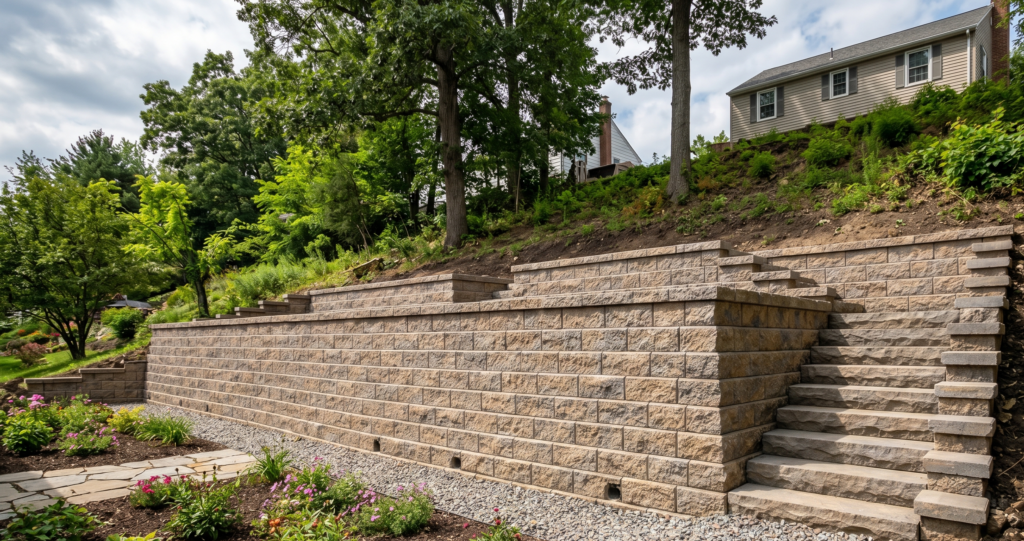
If your Amherst yard features a particularly steep or tall incline, building one massive, monolithic retaining wall might not be the safest or most visually appealing route. Instead, hardscape professionals frequently recommend a terraced (or stepped) wall design.
Benefits of Terracing
Terracing breaks a single, intimidating slope into a series of smaller, manageable steps or tiers. This approach offers several distinct advantages:
- Reduced Pressure: Each individual tier holds back a fraction of the total soil weight, significantly decreasing the risk of structural failure.
- Enhanced Aesthetics: Multi-tiered walls allow you to incorporate built-in planting beds, tier landscaping, and stepped stairways, vastly improving your home’s curb appeal.
- Easier Permitting: By keeping individual walls under the 4-foot threshold, you can often design an elegant solution that is easier to construct safely within local residential code limits.
Critical Engineering Rule for Terraced Walls: To prevent the upper wall from placing an added surcharge load on the lower wall, the distance between the two walls must be at least twice the height of the lower wall. For example, if your bottom wall is 3 feet tall, the second wall must be set back at least 6 feet behind it.
Frequently Asked Question
How close can two terraced retaining walls be built to each other?
To keep the upper wall from pushing down on the lower wall, the horizontal setback space between the two structures must be at least double the height of the lower wall ($Setback = 2 times Height$). If the walls are built too close together, Google Maps-verified engineering guidelines dictate that they must be treated as a single, ultra-tall wall, requiring a full building permit and structural tie-backs like geogrid mesh.
6. Hardscaping Services Near Me: Our Amherst Service Area
When you are looking for a reliable retaining wall contractor near you, proximity and a deep understanding of local neighborhood regulations matter. We engineer custom earth-retaining systems across the entire Town of Amherst and its immediate surrounding communities, including:
- Williamsville (14221): Custom masonry and terraced blocks built to blend seamlessly with historic neighborhood aesthetics and property setback guidelines.
- Eggertsville & Snyder (14226): Resolving structural slope and basement drainage issues for established homes with dense clay soils.
- East Amherst (14051): Large-scale backyard levelling, structural grading, and patio terracing for expansive sloped properties.
- Getzville (14068): Erosion control and decorative retaining walls engineered near major thoroughfares and university-adjacent residential developments.
Whether your property borders Tonawanda or Clarence or sits right in the heart of central Amherst, our team handles the entire process—from pulling local building permits to ensuring your foundation sits well below the local frost line.
Frequently Asked Question
How do I find a qualified retaining wall contractor near me in Amherst?
Look for a local hardscaping company that specializes explicitly in structural earth-retention, carries comprehensive commercial liability insurance, and holds an active, highly reviewed Google Business Profile within the Buffalo-Niagara region. A qualified local contractor should be completely familiar with Amherst’s specific permitting workflows at the Town Hall on Main Street and have a portfolio of local clay-soil installations you can verify.
Find Our Hardscaping Team on Google Maps
When viewing our service map above, you can easily click “Directions” to see how close our dispatch team is to your property, ensuring rapid site visits and accurate, localized project estimates.
Partner with Local Engineering Experts
Building a long-lasting retaining wall on a sloped yard requires a deep understanding of local soils, structural physics, water mitigation, and municipal building codes. While minor, decorative garden borders can be accomplished as DIY tasks, a structural slope correction demands professional-grade equipment, precise engineering, and experienced execution.
If your sloped yard is losing ground to erosion, or if you are ready to unlock the full potential of your property with a beautiful, durable terraced landscape, don’t leave the structural integrity of your home to guesswork. Reach out to a verified, licensed, and highly rated local hardscaping professional on amherstlandscaping.com today to secure a site assessment and turn your challenging slope into a stunning outdoor asset.
More from the blog

Snow Removal Equipment & Tools: Complete Buyer’s Guide
If you've ever watched a plow truck fly past your commercial lot at 5 AM and wondered what it actually takes to…
Read Article
Lawn Mowing Services in Buffalo NY for a Healthy, Beautiful Lawn
A healthy, well-maintained lawn can transform the appearance of your property, improve curb appeal, and create a more enjoyable outdoor space. For…
Read Article
Snow Removal in Buffalo, NY: Your Complete Local Guide
If you've lived here more than one winter, you already know: Buffalo doesn't do "light dusting." We do lake-effect walls of snow…
Read Article