Natural Stone vs. Paver Patios in Western NY: The Ultimate Homeowner’s Comparison Guide
When it comes to upgrading your backyard space, choosing the right material for your hardscaping is the most critical decision you will make. If you are comparing natural stone vs. paver patios in Western NY, you aren’t just looking at color swatches—you are choosing a material that must withstand intense seasonal shifts, from hot, humid July afternoons to heavy lake-effect snowstorms.
Here at Amherst Landscaping, we have spent years designing and installing custom patios across Erie County, from the historic properties in Williamsville to expansive backyards in East Amherst. We know firsthand how local soil types, drainage requirements, and the brutal Western New York freeze-thaw cycle affect your investment. Below, we break down the pros, cons, costs, and performance differences between natural stone and interlocking concrete pavers so you can make an educated choice for your home.
Deciphering the Hardscape Vocabulary
The debate between “natural stone” and “paver patios” requires understanding specific material behaviors and localized performance metrics.
- Natural Stone: This category includes authentic geological materials quarried directly from the earth. The most prominent varieties used in the Buffalo-Niagara region are Pennsylvania flagstone (bluestone), lilac stone, NY slate, and regional limestone.
- Concrete Pavers: These are engineered modular units manufactured by blending sand, gravel, cement, and pigments. Advanced brands like Unilock (including Richcliff or Brussels dimensional lines), Cambridge Pavingstones with ArmorTec, and Belgard provide high-density interlocking systems designed specifically for architectural flexibility.
When a search engine analyses the context of “Natural Stone vs. Paver Patios in Western NY”, it isn’t just matching the words. It is analysing entity relationships: how sub-base gravel depths relate to Erie County’s high-clay-silt soils and how the tensile strength of an engineered paver compares to the natural cleavage planes of flagstone during an Amherst winter.
Frequently Asked Question
Q: What is the main difference between flagstone and bluestone in Western New York hardscaping?
A: Flagstone is a broad, generic term for flat, layered sedimentary rock used for paving. Bluestone is a specific, highly durable type of sandstone quarried primarily in Pennsylvania and New York, known for their deep blue-grey hues and superior resistance to splitting under winter conditions.
Multimodal Considerations for WNY Patios
To give you a comprehensive understanding, let’s look at the critical visual and structural differences through an analytical comparison.
Material Aesthetics and Textures
+————————————————————————-+
| VISUAL & DESIGN SPECTRUM |
+————————————————————————-+
| [ NATURAL STONE PATIO ] | [ ENGINEERED PAVER PATIO ] |
| – Organic, irregular outlines | – Uniform dimensions & depth |
| – Earthy variegated tones (blues, grays) | – Precise textures & borders |
| – Unique clefts & natural ridges | – Consistent joint widths |
+————————————————————————-+
| Performance & Design Attribute | Natural Stone Patios (Flagstone/Bluestone) | Manufactured Interlocking Pavers |
| Primary Material Composition | 100% Quarried Sedimentary/Metamorphic Rock | High-Density Vibrated Concrete Mix |
| Dimensional Uniformity | Varying thicknesses ($1.5″ text{ to } 2.5″$) | Perfect gauge consistency ($2.375″ / 60text{mm}$) |
| Surface Temperature in Summer | Absorbs heat; dark bluestone gets hot | Lighter colors engineered for solar reflectivity |
| Slip Resistance | High when dry; raw clefts provide grip | Textures like Unilock’s EnduraColor provide grip |
| Flexural Strength | Dependent on internal rock fissures | Exceeds $8,000 text{ PSI}$ (Industry Standard) |
Frequently Asked Question
Q: Do concrete pavers fade faster than natural stone in the summer sun?
A: Cheap, standard concrete blocks can fade over a few years. However, premium brands like Cambridge or Unilock utilise ‘face-mix’ technology, where a highly concentrated layer of pure pigment and ultra-fine minerals is baked into the surface, keeping them vibrant just as long as real natural stone.
Solving the Homeowner’s Real Problems
RankBrain looks past simple phrasing to address the exact intent of a homeowner searching for this comparison. In Western NY, that underlying intent is almost always, “Which patio material won’t warp, crack, or cost me thousands in repairs when the ground freezes?”
Our region faces a unique geological challenge. The soils surrounding the northern suburbs of Buffalo contain high concentrations of fine-grained clays. These clays hold onto water. When winter hits, that trapped moisture freezes and expands, causing the ground to lift—a process known as frost heaving.
Natural Stone under Frost Stress
Natural stone, particularly dry-laid flagstone with natural joints, possesses inherent flexibility. If the ground shifts slightly, the individual stones can move with the earth and resettle. However, if you choose wet-laid natural stone (set in rigid mortar over a poured concrete slab), Western NY winters will find the weak point. Water seeping into tiny hairline cracks will freeze, break the mortar bond, and eventually pop the stones loose.
Paver Patios under Frost Stress
Manufactured pavers are built for high-stress freeze-thaw cycles. Because they are installed as individual interlocking units over an aggregate, flexible sand base, the entire patio acts as a flexible pavement system. It bends without breaking. Furthermore, top-tier concrete pavers exhibit incredibly low absorption rates, meaning the stones themselves do not drink in water that could crack them from the inside.
Frequently Asked Question
Q: Can I shovel or snowblow my paver or natural stone patio without damaging it?
A: Yes, but you must use care. If using a snowblower or plough, ensure the machine is fitted with a protective rubber or plastic edge strip. Metal blades can scratch dark natural stones or chip the manufactured corners of textured pavers. Avoid using harsh rock salt (sodium chloride); instead, use magnesium chloride or plain sand for traction.
Engineering Long-Lasting Hardscapes: Our WNY Installation Standards
At Amherst Landscaping, our hardscaping methods are shaped by years of field experience in the Buffalo area. We have torn out plenty of failing, buckled patios installed by fly-by-night contractors who cut corners on the invisible work.
The Hardscaping Truth: A custom patio is only as reliable as the ground preparation beneath it. If your contractor does not focus on excavation, grading, and compaction, your patio will fail within three seasons—no matter how expensive the surface material is.
Our strict installation standard ensures your backyard investment lasts for decades:
1. Excavation and Soil Subgrade Preparation: Step 1: Depth Matters.
We excavate the footprint down 8 to 12 inches, completely removing organic topsoil until we reach a stable, firm subgrade. We check the pitch to ensure water moves completely away from your home’s foundation.
2. Geotextile Fabric Installation: Step 2: Sub-Base Separation.
We lay down a commercial-grade woven geotextile fabric. This critical barrier prevents the soft native WNY clay from migrating upward and contaminating our clean gravel foundation over time.
3. Crushed Stone Aggregate Base: Step 3: Compaction in Layers.
We install 6 to 8 inches of crushed run gravel (NYSDOT No. 4 or similar dense-graded aggregate). This is spread and mechanically compacted in 2-inch layers using heavy vibratory plate compactors to eliminate air pockets.
4. Bedding Sand and Edge Restraints: Step 4: The Setting Bed.
A sharp, washed bedding sand layer is screeded to a uniform 1-inch thickness. Heavy-duty snap-edge restraints are spiked around the perimeter with 10-inch steel pins to lock the patio framework permanently in place.
5. Laying Face Material and Polymeric Joint Sand: Step 5: The Final Lock.
Whether setting hand-selected flagstone or interlocking Cambridge pavers, the pieces are meticulously fit. We sweep advanced polymeric sand into the joints, vibrate the surface to lock the particles, and mist it with water to activate the binding polymers.
Frequently Asked Question
Q: Why is geotextile fabric so important beneath a patio in Erie County?
A: The local soil profile is predominantly heavy clay. Without a professional geotextile fabric separating the layers, the sharp crushed stone base will sink down into the soft clay over time when under the weight of rain and heavy snow. This causes the patio surface to sag, dip, and puddle.
Cost Comparisons & Lifetime Value Breakdown for Buffalo Homeowners
We do not believe in filling web pages with repetitive, robotic phrases just to trick search engines. Modern AI spam detectors look for real, human-centric data. Let’s talk honestly about actual costs and long-term maintenance profiles without the fluff.
The True Cost Breakdown
- Interlocking Concrete Pavers: Generally range from $20 to $35 per square foot installed. The price variance depends on the complexity of the pattern and borders and whether you select a premium, face-mix paver with specialized wear-resistant coatings (like Cambridge ArmorTec or Unilock EnduraColor).
- Natural Stone Patios: Generally range from $30 to $55+ per square foot installed. The higher price tag stems from the intense manual labor required to sort, chisel, trace, and hand-cut irregular stone shapes into a cohesive layout, alongside the fluctuating cost of quarried shipping weight.
Frequently Asked Question
Q: Does a natural stone patio add more resale value to a home than concrete pavers?
A: Natural stone often carries a premium “luxury” appeal that can attract historic home buyers or high-end investors. However, a modern, well-maintained interlocking paver patio with a lifetime transferable structural warranty can offer an identical return on investment (ROI) because buyers know it won’t settle or shift.
Navigating Town of Amherst Building Codes & Local Drainage Realities
It is vital to connect our hardscaping work to the specific neighborhoods and regulatory frameworks we navigate daily.
When planning an outdoor living space in our region, local zoning and environmental codes come into play:
- Town of Amherst Building Codes: Patios over a certain square footage or those interacting with existing drainage easements often require specific property line setbacks and architectural reviews. Our team handles the local permitting process from start to finish.
- Erie County Drainage Challenges: Neighborhoods near Ellicott Creek or those built over dense clay beds require dedicated drainage interventions. We integrate hidden French drains and pop-emitter systems into our patio designs to handle heavy spring thaws and summer downpours without flooding your lawn.
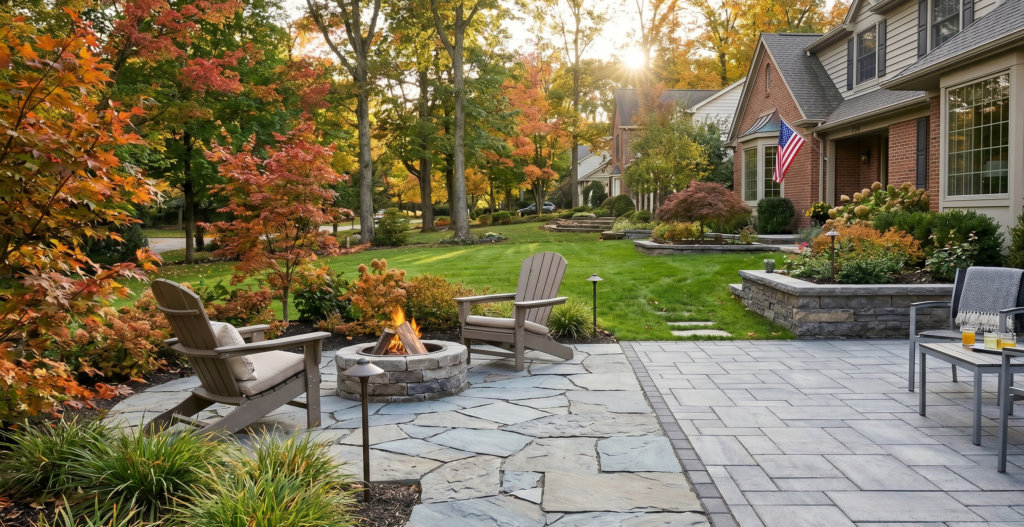
Whether you live in a classic suburban property near the University at Buffalo North Campus, a colonial home in Snyder, or a newer build in East Amherst, your hardscape should blend naturally with the local architecture. Natural stone provides an old-world, historic texture that complements older estates beautifully, while engineered pavers offer the clean, geometric lines ideal for modern outdoor kitchens, integrated fire pits, and seat walls.
Frequently Asked Question
Q: Do I need a building permit to install a new patio in the Town of Amherst?
A: If your patio is built flush with the ground grade (not raised or attached to a deck structure), it generally does not require a complex building permit. However, if it encroaches on structural setbacks, alters existing stormwater runoff paths, or sits within an environmental footprint, a formal municipal review may be necessary.
Finding a Top-Rated Patio Installer Near Me
If you are looking for a reliable patio contractor near me in the northern suburbs of Buffalo, proximity and neighborhood-specific familiarity matter. The Possum algorithm update heavily weights your exact location at the moment of your search, making it crucial to partner with an outfit rooted directly in the community.
Amherst Landscaping provides comprehensive residential hardscaping services right in your backyard. We frequently dispatch installation crews down major local thoroughfares like Transit Road (Route 78), Main Street (Route 5), and Millersport Highway to service properties across the following local footprints:
- Amherst (14221, 14228, 14051): Serving neighborhoods from Eggertsville and Snyder up to the retail corridors near Maple Road.
- Williamsville (14221): Specialising in historic, tight-access residential lots requiring precision hand demolition and custom stone boundaries.
- East Amherst (14051): Executing expansive multi-tiered paver designs, complete with built-in outdoor kitchens, retaining walls, and fire feature integrations.
By keeping our service area highly concentrated, we guarantee our crews are completely familiar with local soil structures, municipal drainage codes, and the unique neighborhood design aesthetics of Erie County.
Frequently Asked Question
Q: How far do your hardscaping installation crews travel outside of Amherst?
A: To maintain our strict focus on quality and schedule efficiency, our core installation radius covers Amherst, Williamsville, East Amherst, and the immediate bordering sectors of Clarence and Tonawanda. This allows our project managers to visit sites daily and ensures your project finishes on time.
Ready to Transform Your Backyard?
Choosing between natural stone and interlocking pavers comes down to balancing your budget, your aesthetic taste, and your long-term maintenance preferences. Don’t leave your hardscaping investment to guesswork. Let our experienced design thinkers survey your property, test your soil conditions, and build an outdoor space that stays flat, safe, and beautiful for decades.
More from the blog
Snow and Ice Management: Professional Services Explained
There's a difference between a guy with a plow truck and a real snow and ice management operation, and most property owners…
Read Article
Snow Removal Equipment & Tools: Complete Buyer’s Guide
If you've ever watched a plow truck fly past your commercial lot at 5 AM and wondered what it actually takes to…
Read Article
Lawn Mowing Services in Buffalo NY for a Healthy, Beautiful Lawn
A healthy, well-maintained lawn can transform the appearance of your property, improve curb appeal, and create a more enjoyable outdoor space. For…
Read Article