
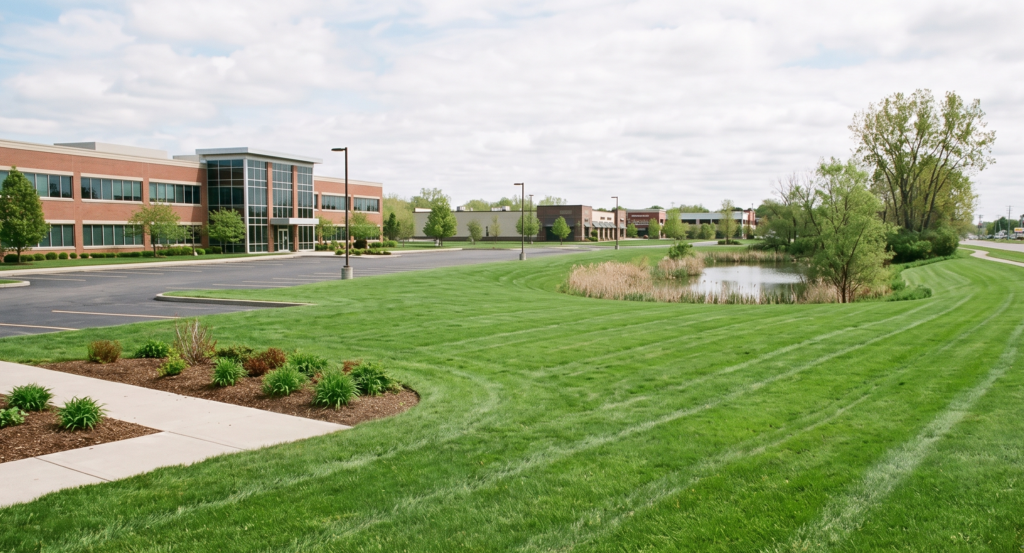
Weed Control Strategies for Large Commercial Lawns in WNY
Managing a massive commercial footprint in Western New York (WNY) comes with a unique set of challenges. Between our notoriously unpredictable spring weather, high humidity spikes in July, and expansive acreage that can easily hide outbreaks until they become full-blown infestations, standard residential lawn care tactics simply won’t cut it.
For property managers across Buffalo, Amherst, Cheektowaga, and Clarence, an overgrown or weed-infested lawn isn’t just an eyesore—it directly impacts corporate image, tenant satisfaction, and property value.
Developing an enterprise-grade weed control strategy requires moving away from reactive “weed zapping” and transitioning into a proactive, agronomic framework specifically engineered for the Great Lakes climate. Here is how commercial properties in WNY can achieve pristine, weed-free turf across large acreages.
1. The Core Challenge: WNY’s Soil & Climate Matrix
Large commercial properties in Amherst and the greater Buffalo area typically contend with two primary soil profiles: dense, poorly draining heavy clay or highly compacted fill dirt left over from commercial construction. When you combine these tight, low-oxygen soils with WNY’s extreme seasonal swings—freezing winters, rapid spring thaws, and humid summers—you create the absolute perfect breeding ground for opportunistic weeds.
Compacted clay soils naturally restrict turfgrass root growth, leaving commercial lawns thin and vulnerable. Weeds like dandelion, broadleaf plantain, and crabgrass thrive in these exact conditions because their aggressive root systems can easily penetrate dense earth where weaker turfgrass suffocates.
Furthermore, the sheer scale of large commercial properties means varied microclimates exist on a single site. A sprawling corporate campus might have waterlogged low zones near retention ponds, high-traffic pedestrian areas compacted by foot traffic, and scorching, reflective heat zones adjacent to massive asphalt parking lots. A one-size-fits-all spray program will inevitably fail in at least one of these zones.
Frequently Asked Questions
Why is my commercial lawn more prone to weeds than residential ones?
Commercial sites often suffer from severe soil compaction due to construction and heavy traffic, which weakens the grass and allows opportunistic weeds to take over.
Does WNY’s climate really impact weed growth?
Absolutely. The rapid transitions from wet, cold springs to humid summers create stress cycles that weaken turf and favor aggressive, resilient weed species.
2. The Foundation: Split-Application Pre-Emergent Barriers
For large commercial acreages, the most cost-effective and logistically sound weapon is pre-emergent weed control. Trying to spot-treat twenty acres of erupted crabgrass in July requires massive amounts of post-emergent herbicide and expensive labor hours and results in visible, yellowing dead spots across the lawn. Pre-emergents stop the problem before it starts by creating a chemical barrier in the top layer of soil that disrupts the germination cycle of weed seeds.
However, because WNY springs are highly erratic—often shifting from a late snowstorm straight into a 70-degree week—timing a single pre-emergent application is incredibly risky. If the barrier is applied too early, heavy spring rains can wash it away or dilute it before the seeds wake up. If applied too late, the seeds have already germinated beneath the surface, rendering the application useless.
The solution for enterprise lawns is a split-application strategy:
- Application 1 (Early Spring): Applied right as soil temperatures approach 50 to 55 degrees Fahrenheit (typically concurrent with the blooming of local Forsythia bushes). This establishes the initial defensive shield, targeting early germinating annual grasses.
- Application 2 (Late Spring/Early Summer): Applied roughly 6 to 8 weeks later. This extends the longevity of the chemical barrier through the crucial early summer months, catching late-germinating seeds and reinforcing areas thinned out by heavy rainfall.
By splitting the dosage, commercial properties achieve continuous protection without exceeding environmental threshold limits, keeping high-visibility zones flawless through the summer peak.
Frequently Asked Questions
What is a “split application,” and why do we need it?
In WNY, our erratic spring temperatures make it hard to time the perfect pre-emergent window. Applying in two halves ensures the barrier lasts through the entire germination season.
Will pre-emergents hurt my existing grass?
No. Pre-emergent herbicides are designed to target only germinating seeds and do not negatively affect established, mature turfgrass.
3. Targeted Post-Emergent Control & Selective Herbicides
Even with an immaculate pre-emergent program, tough perennial broadleaf weeds will inevitably find a way through, driven by wind-blown seeds or birds. In a large-scale commercial setting, blanket-spraying post-emergent herbicides across entire fields is environmentally irresponsible and financially wasteful. Instead, a successful program relies on high-efficiency, targeted applications using selective herbicides.
Selective herbicides are formulated to target specific weed biology while leaving the surrounding cool-season turfgrasses (like Kentucky Bluegrass, Perennial Ryegrass, and Tall Fescue) completely unharmed.
Common WNY Commercial Invaders & Target Strategies
- Dandelions & White Clover: These are the most common broadleaf disruptors in WNY. They are best managed with systemic selective herbicides applied during periods of active growth. When targeted in late spring or early autumn, the weed absorbs the compound through its leaves and transports it down to the root, ensuring total eradication.
- Crabgrass & Foxtail: If annual grasses break through the pre-emergent shield, they require specialized post-emergent grass killers. These must be applied while the weed is still young for maximum efficacy.
- Nutsedge: Thriving in the low-lying, poorly drained clay zones common around WNY commercial parks, this yellow, grass-like sedge requires specialized sedge-killing agents. Standard broadleaf weed killers will not affect it.
Frequently Asked Questions
What is the difference between selective and non-selective herbicides?
Selective herbicides target specific weeds while leaving your grass alone. Non-selective herbicides (like glyphosate) kill everything they touch, which is rarely appropriate for a commercial lawn.
Why can’t I just spray the whole property at once?
Beyond being environmentally costly, blanketing a whole property is inefficient and can actually cause more stress to your turf than a precision-targeted approach.
4. Cultural Management: Turf Density as Natural Defense
The most overlooked component of commercial weed control is recognizing that the best weed killer is a dense, healthy lawn. Weeds are natural opportunists; they require sunlight, space, and bare soil to establish themselves. If your commercial turf is thick, robust, and mowed correctly, it will naturally choke out weed seedlings by blocking their access to sunlight and vital root space.
Enterprise Mowing Height Standards
Many commercial cutting crews make the mistake of mowing turf too short (scalping) in an effort to extend the time between cuts. For commercial properties, cool-season turf should consistently be maintained at a height of 3.5 to 4 inches.
Mowing at this higher threshold provides vital shade to the soil surface, keeping soil temperatures lower (which slows weed seed germination) and drastically reducing the sunlight available to rogue seedlings. Furthermore, longer grass blades allow for deeper root penetration, making the lawn far more resilient against summer droughts.
Strategic Aeration and Overseeding
Because commercial properties experience heavy compaction from maintenance equipment, vehicles, and foot traffic, annual or biennial mechanical core aeration is vital. Aeration punches holes through the thatch and compacted clay, allowing oxygen, water, and nutrients to reach the turf root zone. Following up immediately with a heavy overseeding of turf-type tall fescue blends fills in thin patches, closing the door on potential weed invasions before the next season begins.
Frequently Asked Questions
How does mowing height help control weeds?
Keeping grass at 3.5 to 4 inches shades the soil surface, depriving weed seeds of the sunlight they need to germinate.
When is the best time for aeration?
For commercial lawns in WNY, early autumn is the gold standard, as the cooling soil temperatures and increased rainfall provide the best conditions for seed germination.
5. Enterprise-Scale Logistics, Safety, and Environmental Compliance
Managing weed control across multiple acres requires rigid adherence to safety protocols and environmental regulations. New York State maintains strict guidelines regarding commercial pesticide applications, requiring precise record-keeping, specific licensing, and visible public notification.
Advanced Application Technology
For massive lawns, relying on small walk-behind spreaders or hand-pump sprayers is inefficient. Professional commercial fleets utilize heavy-duty, calibrated ride-on sprayer/spreader machines equipped with low-drift nozzles. These advanced units ensure perfectly uniform distribution of both granular fertilizers and liquid herbicides, maximizing coverage accuracy while eliminating dangerous chemical drift.
Safety Signage & Public Awareness
Commercial spaces are highly public environments. A professional commercial lawn management program ensures that all treated areas are clearly demarcated with regulatory warning flags immediately following application. Furthermore, scheduling applications during off-peak hours—such as early weekend mornings or late evenings—minimizes public exposure and ensures zero disruption to daily business operations.
Frequently Asked Questions
Are professional weed control programs safe for my employees and tenants?
Yes, when managed by licensed professionals who adhere to state regulations, including proper signage and timing applications during low-traffic periods.
Do you provide documentation for our property’s environmental compliance?
Yes, professional landscaping partners maintain detailed records of applications, products used, and weather conditions, ensuring full transparency and compliance.
6. Commercial Lawn Care Services Near Me (WNY Service Radius)
When managing multi-acre business parks, industrial centers, or retail spaces, finding a reliable commercial lawn care service near me means finding a team that understands local county regulations and regional soil demands.
Local proximity ensures rapid response times for weather-dependent treatments and regular property audits. A truly local provider doesn’t just spray your turf; they monitor micro-local weather patterns across Erie and Niagara counties to execute applications under optimal atmospheric conditions.
Strategic Regional Coverage
Enterprise turf management requires extensive regional knowledge. Proximity optimization involves balancing treatment schedules between properties situated right along the major transit corridors of Western New York, including the following:
- Amherst & Williamsville: Balancing high-visibility corporate parks along Main Street and the I-290 corridor.
- Clarence & Lancaster: Managing expansive commercial lots and retail footprints along Transit Road (Route 78).
- Buffalo & Cheektowaga: Addressing high-compaction areas surrounding urban industrial facilities and logistics hubs near the I-90.
Frequently Asked Questions
Why should I choose a commercial lawn care company near me instead of a national chain?
Local providers understand WNY’s specific microclimates, unique soil compositions, and regional weed patterns, resulting in highly customized and responsive care.
How far do your commercial lawn management teams travel?
Elite local crews service the entire greater Western New York region, covering all major commercial corridors throughout Erie and Niagara counties.
Why WNY Businesses Trust Amherst Landscaping
Maintaining a pristine, weed-free presentation across a large commercial asset requires deep agronomic knowledge, heavy enterprise equipment, and strict compliance with local environmental standards.
At Amherst Landscaping, we specialize in customized turf management programs built specifically for Western New York’s distinct climate challenges. From multi-stage pre-emergent barriers to precision broadleaf control and large-scale mechanical core aeration, our licensed professionals keep your corporate property looking immaculate, professional, and welcoming all year round.
Find Our Local Office & Real-Time Directions
To ensure consistent results, always verify that your landscaping partner holds an active New York State Department of Environmental Conservation (NYSDEC) Commercial Pesticide Applicator certification.
Ready to elevate your commercial property’s curb appeal? Contact the commercial turf experts at Amherst Landscaping today to schedule a comprehensive property site assessment and custom weed management consultation.
More from the blog
Snow and Ice Management: Professional Services Explained
There's a difference between a guy with a plow truck and a real snow and ice management operation, and most property owners…
Read Article
Snow Removal Equipment & Tools: Complete Buyer’s Guide
If you've ever watched a plow truck fly past your commercial lot at 5 AM and wondered what it actually takes to…
Read Article
Lawn Mowing Services in Buffalo NY for a Healthy, Beautiful Lawn
A healthy, well-maintained lawn can transform the appearance of your property, improve curb appeal, and create a more enjoyable outdoor space. For…
Read Article