7 Front Yard Landscaping Ideas to Boost Amherst Curb Appeal
First impressions start at the driveway. When neighbors walk past or guests arrive at your front door, your outdoor layout tells a story before anyone steps inside. In our distinct northern climate—where freezing winters give way to humid, vibrant summers—a front lawn needs more than a simple mowing routine to stand out. Smart design connects structural hardscaping with cold-hardy, deep-rooted plant choices that withstand heavy snowfall, clay-heavy soil, and summer droughts.
Whether you are looking to refresh aging foundation shrubs, add warm evening lighting, or replace a patchy front lawn with native flower beds, updating your property makes a measurable difference in curb appeal and home value. Here are seven field-tested landscape design ideas tailored specifically for Amherst properties.
1. Frame Your Entrance with Goshen Stone Walkways
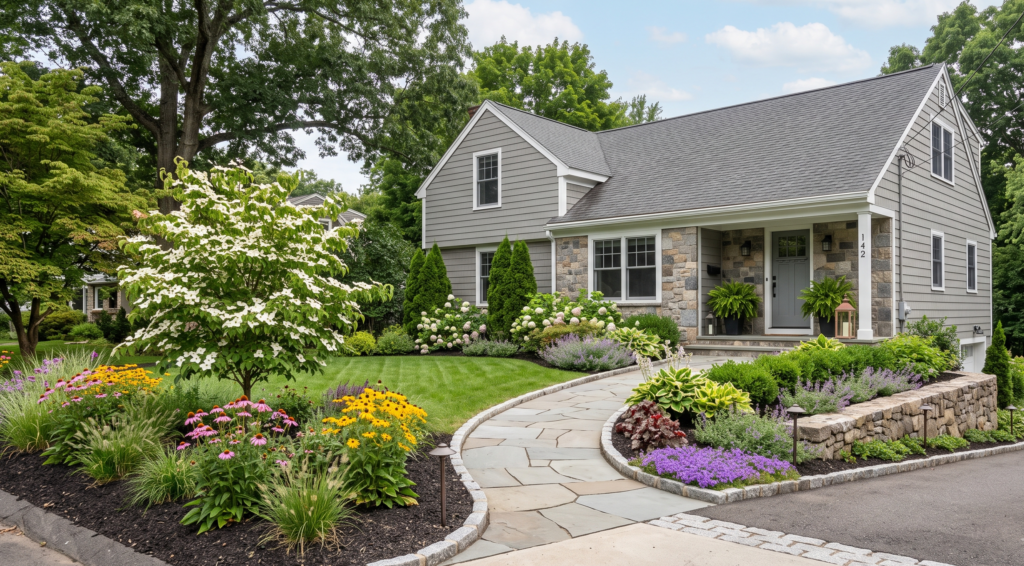
A cracked, narrow concrete path leading to your front step makes an entry feel cramped and dated. Upgrading your front pathway using regionally quarried natural stone—such as rugged Goshen stone or layered fieldstone—instantly grounds your property in local architectural history.
Why Hardscaping Works for Local Homes
- Freeze-Thaw Resistance: Unlike poured concrete, which cracks under winter thermal movement, flexible stone paver systems or mortared natural flagstones shift naturally without structural failure.
- Visual Width: Designing pathways at a minimum width of 4 to 5 feet allows two people to walk side-by-side comfortably, creating an open invitation toward your front porch.
- Textural Contrast: Deep gray and rustic bronze stone tones provide a striking contrast against soft green lawns and bright perennial borders.
+—————————————————————–+
| FRONT PORCH / ENTRY |
+—————————————————————–+
|
[Broad Landing: 5′ – 6′ Wide]
|
/———————–+———————–
/
[Soft Curve Path] [Native Plant Bed]
Goshen Stone / Pavers Hydrangeas & Ferns
/
———————–+———————–/
|
[Driveway/Street Access]
Frequently Asked Questions
Q: Why is Goshen stone preferred over standard concrete pavers in our region?
A: Goshen stone is a locally quarried mica schist that naturally handles northern winter moisture and freeze-thaw cycles without scaling, spalling, or cracking the way concrete products often do over time.
Q: How do I keep weeds from growing between flagstones on a front path?
A: Installing a dense aggregate base with high-grade geotextile fabric beneath the stones, paired with polymeric sand or stone dust in the joints, prevents weed seeds from taking root.
2. Layer Tiered Foundation Beds for Year-Round Dimension
Many older homes in the area suffer from “bowling alley syndrome”—a straight, single row of overgrown boxwoods or yews pinned flat against the front siding. Breaking out of this linear pattern requires layered planting depths.
Create a bed that extends 6 to 8 feet out from your foundation, building three distinct horizontal layers:
+——————————————————————-+
| BACKLAYER (Tall): Columnar Arborvitae, Serviceberry, Lilac |
+——————————————————————-+
| MIDDLE LAYER (Mid): Kousa Dogwood, Oakleaf Hydrangea, Boxwood |
+——————————————————————-+
| FRONT LAYER (Low): Catmint, Coral Bells, Creeping Phlox |
+——————————————————————-+
Choosing the Right Flora for Local Soil
Our regional soil ranges from fertile alluvial silt near water basins to dense, moisture-retaining clay. Incorporating species like Kousa Dogwood, Oakleaf Hydrangea, and Inkberry Holly provides structured height while resisting common regional pests and damp roots.
Frequently Asked Questions
Q: How far away from the home’s foundation should I plant shrubs?
A: Plant small to medium shrubs at least 2 to 3 feet away from the foundation at mature width. This maintains proper airflow, prevents basement moisture issues, and gives roots room to expand.
Q: What shrubs retain their foliage during heavy winter snow?
A: Broadleaf evergreens like inkberry holly and mountain laurel, along with dwarf conifers like Siberian cypress, keep their foliage and structural shape throughout snow-heavy winter months.
3. Transition High-Maintenance Grass into Pollinator-Friendly Beds
Maintaining a pristine green lawn on sloped or heavily shaded front yards takes significant time, water, and seasonal chemical treatments. Converting high-maintenance turf areas into native perennial gardens cuts down on weekly mowing while attracting local pollinators.
Top Native Selections for Western Massachusetts & Western New York
- Purple Coneflower (Echinacea purpurea): Handles full sun, poor soil, and summer heat without drooping.
- Black-Eyed Susan (Rudbeckia fulgida): Offers golden blooms from mid-summer straight through early autumn frost.
- Pennsylvania Sedge (Carex pensylvanica): Excellent fine-textured groundcover for shady trees where lawn grass fails to grow.
- New England Aster (Symphyotrichum novae-angliae): Delivers late-season purple blooms when most garden flowers fade.
Pro Tip: Apply a 3-inch layer of dark, double-shredded hardwood mulch over newly planted beds. This retains soil moisture during dry summer stretches, suppresses weeds, and insulates shallow root systems through icy winter freezes.
Frequently Asked Questions
Q: Will native plant beds look messy during the winter dormant season?
A: Not if you incorporate structural evergreen accents and leave decorative seed heads on species like coneflowers and ornamental grasses, which offer winter interest and feed songbirds.
Q: How do native perennials reduce front yard irrigation costs?
A: Once established in their second season, native perennials develop deep root systems tailored to local rainfall patterns, requiring far less supplemental watering than lawn turf.
4. Install Low-Voltage LED Architectural and Path Lighting
A well-designed front yard should look captivating after the sun sets. Low-voltage landscape lighting improves safety along walkways while accentuating the architectural features of your home and mature trees.
[ Uplight ] [ Path Light ]
|| ||
/=========== +======+
/ Tree | |
/ Canopy | / |
===============/ +==||==+
|| ||
=========||==============================||========
[ Ground ] [ Walkway ]
Strategic Placement Principles
- Up-Lighting: Position warm-tone LED fixtures at the base of ornamental trees like river birch or Japanese maple to cast dramatic shadows against the front elevation.
- Path Illumination: Stagger path lights along your main walkway—avoid alignment in straight, parallel lines, which can look like an airport runway.
- Hardscape Wash Lights: Hide micro-fixtures under retaining wall capstones or porch steps to highlight natural stone textures and prevent tripping.
Frequently Asked Questions
Q: Do low-voltage LED landscape lights survive snow plowing and winter frost?
A: Professional-grade brass or cast aluminum fixtures set slightly back from driveways withstand freezing temperatures and moisture much better than light plastic solar stakes.
Q: What color temperature lighting works best for outdoor residential landscapes?
A: A warm white temperature between 2700K and 3000K flatters architectural stone and foliage tones without producing harsh blue light or glare.
5. Build Stone Retaining Walls to Tame Sloped Front Lawns
Many properties across the Pioneer Valley and Western New York feature rolling terrain or steep front slopes that drop toward the roadway. Heavy spring rain washes nutrients out of sloped topsoil, leaving patchy grass and exposed roots.
Installing stacked stone or textured concrete block retaining walls solves slope erosion while adding crisp, structural elevation lines to your front landscape.
UNTERRACED SLOPE (Erosion Prone) TERRACED WALL (Stable & Functional)
/ |———– Bed 2 (Shrubs)
/ <– Soil washes away |
/ +——-+ <– Retaining Wall 2
/ |———– Bed 1 (Perennials)
/ |
/ +—+ <– Retaining Wall 1
Terraced retaining walls break aggressive slopes into manageable, level garden terraces. Integrating built-in stone steps creates clean access points from the sidewalk or street parking.
Frequently Asked Questions
Q: Do I need built-in drainage behind a front yard retaining wall?
A: Yes. Trapped groundwater behind a wall creates hydrostatic pressure that causes walls to tilt or bulge. A perforated drain pipe enveloped in crushed stone is essential for long-term wall stability.
Q: When is a retaining wall project complex enough to require engineering?
A: Walls over 3 to 4 feet in total height generally require engineered soil reinforcement, geogrid grids, or structural permits depending on municipality codes.
6. Create Visual Focus with Architectural Accent Trees
Every captivating front yard needs a focal point—a single feature that catches the eye and draws attention away from utilitarian elements like air conditioning units or utility meters. A small, ornamental specimen tree serves as an anchor for the rest of your landscape design.
| Specimen Tree | Mature Height | Key Feature | Seasonal Interest |
| Paperbark Maple (Acer griseum) | 15–20 ft | Exfoliating cinnamon bark | Brilliant red fall foliage & winter bark |
| Kousa Dogwood (Cornus kousa) | 20–25 ft | Star-shaped spring bracts | Crimson berries & purple autumn leaves |
| Serviceberry (Amelanchier) | 15–25 ft | White spring blossoms | Edible summer berries & orange fall colors |
| Weeping Japanese Maple | 6–10 ft | Delicate cascading canopy | Deep purple or bright green summer leaves |
Plant your focal tree off-center relative to the front entrance to create dynamic visual balance rather than stiff symmetry.
Frequently Asked Questions
Q: Where is the best spot to position a focal tree in a front yard?
A: Place focal trees slightly off-center inside a wide garden bed to frame home architectural features, rather than planting them directly in the middle of a lawn.
Q: Will ornamental tree roots damage home foundation walls or walkways?
A: Smaller accent trees like dogwoods and serviceberries have non-invasive, compact root systems that pose little risk to foundation structures when planted at proper distances.
7. Elevate the Approach with Custom Driveway Edging
Driveways occupy a significant percentage of front yard visual space. Plain asphalt edges frequently crumble over time, leading to frayed lawn borders and unsightly weed growth.
Defining your driveway perimeter with granite cobblestones (Belgian blocks), concrete pavers, or a continuous stone curbing instantly elevates your entire entrance.
+——————————————————–+
| ASPHERIC DRIVEWAY |
+——————————————————–+
========================================================== <– Granite Belgian Block Curb
…………………………………………………. <– Mulch / Plant Bed Boundary
[Lavender] [Catmint] [Ornamental Grasses]
Benefits of Cobblestone Edging
- Structural Protection: Keeps heavy vehicular tires off delicate lawn edges, preventing rutting during winter thaws.
- Clean Edging Line: Acts as a physical barrier that stops mulch from washboarding onto the pavement during downpours.
- Clean Lines: Provides a crisp, professional margin that makes regular lawn edging quick and easy.
Frequently Asked Questions
Q: How are granite Belgian blocks installed along asphalt driveways?
A: Blocks are set into a concrete trench footing with a rear concrete backing to lock them firmly in place against vehicle pressure and snow plow impacts.
Q: Does driveway curbing interfere with winter snow removal?
A: Flush or slightly raised bevel-set block borders actually mark the pavement edge clearly for plow operators, guarding lawn turf from gouges.
Searching for Local Landscaping Services Near Me?
If you are searching for a trusted landscaping company near me or need expert hardscape contractors in the local area, working with a team that understands regional microclimates makes all the difference. We provide full-service outdoor design, paver installation, stone retaining walls, and custom planting plans across our immediate community and surrounding neighborhoods.
Our Primary Local Service Areas:
- Downtown & North Amherst
- South Amherst & Hadley Borders
- Pioneer Valley Neighborhoods
- Surrounding Regional Communities
Visit Our Local Office & Get Directions
Transform Your Front Yard with Local Expertise
A thoughtfully designed front yard does more than raise property value—it welcomes you home every day with vibrant color, structural harmony, and seasonal texture. From selecting cold-hardy native flora to installing durable Goshen stone hardscaping, building a resilient landscape requires a clear understanding of local soils, climate demands, and architectural context.
Ready to elevate your home’s exterior? Contact our professional design team at Amherst Landscaping today to schedule your initial site consultation. Let’s bring your vision to life!
More from the blog

Snow Removal Equipment & Tools: Complete Buyer’s Guide
If you've ever watched a plow truck fly past your commercial lot at 5 AM and wondered what it actually takes to…
Read Article
Lawn Mowing Services in Buffalo NY for a Healthy, Beautiful Lawn
A healthy, well-maintained lawn can transform the appearance of your property, improve curb appeal, and create a more enjoyable outdoor space. For…
Read Article
Snow Removal in Buffalo, NY: Your Complete Local Guide
If you've lived here more than one winter, you already know: Buffalo doesn't do "light dusting." We do lake-effect walls of snow…
Read Article