Core Aeration vs. Dethatching for Amherst Yards
When reviving a struggling Western New York lawn, deciding between core aeration and dethatching is one of the most critical maintenance choices an Amherst property owner can make. While both turf treatments aim to restore vigor, improve airflow, and boost nutrient delivery, they target two completely different root-zone issues. Applying the wrong mechanical process to your turfgrass can cause unnecessary stress, tear up healthy root crowns, increase broadleaf weed pressure, and leave your soil vulnerable to summer drought.
To determine the ideal seasonal maintenance program for your property, let’s explore how core aeration and dethatching work, how Amherst’s heavy clay subsoils dictate your lawn care schedule, and how local turf professionals decide which solution best fits your yard.
What Is Core Aeration?
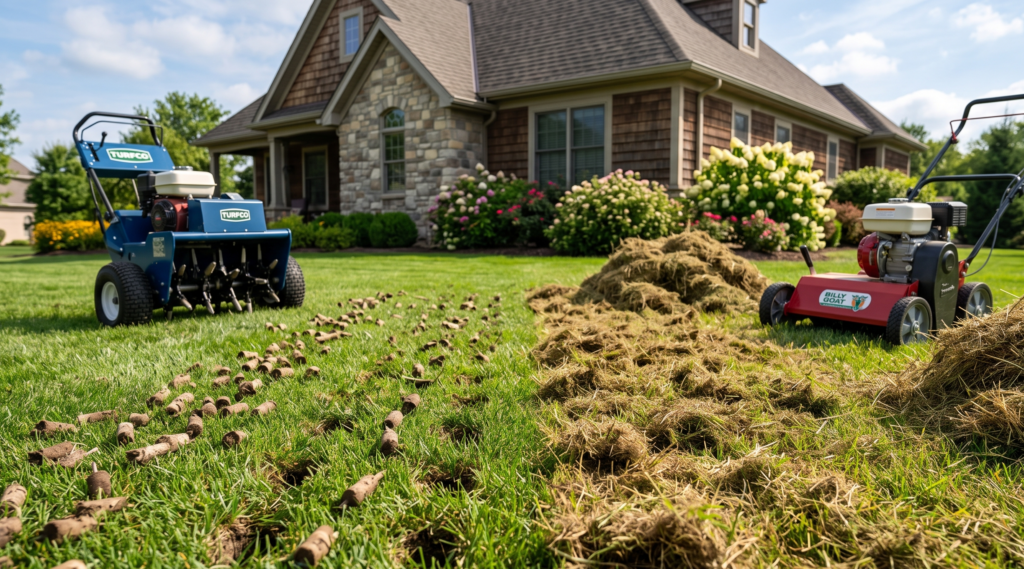
Core aeration, commonly referred to as plug aeration, is a mechanical lawn restoration process where a commercial turf aerator extracts cylindrical cores of soil, thatch, and roots across your turf. These plugs typically measure between 0.5 and 0.75 inches in diameter and penetrate 2 to 4 inches deep into the soil profile.
Once extracted, these plugs remain on the lawn surface to break down naturally over one to two weeks through routine mowing, rainfall, and irrigation. As the plugs disintegrate, they redistribute beneficial soil microorganisms across the upper thatch layer, speeding up natural decomposition.
- Relieves Soil Compaction: It loosens dense, tightly packed subsoil particles caused by lawn mowers, foot traffic, and months of winter snowpack.
- Creates Seed-to-Soil Contact: The open core holes provide protected micro-environments that shield grass seed from wind and birds, substantially increasing germination rates during fall overseeding.
- Enhances Water and Oxygen Infiltration: It opens direct pathways through the root zone, preventing surface runoff, soggy puddling, and standing water.
- Encourages Deep Root Growth: Cool-season turf roots naturally migrate toward open pockets where oxygen, water, and starter fertilizer are readily available.
Frequently Asked Questions
Should I rake up the soil plugs left behind after aerating?
No. Leave the extracted soil cores directly on the lawn. As you mow and water, they will crumble and dissolve within 7 to 14 days, filtering vital nutrients and microbes back down into the root system.
How often should an Amherst lawn be aerated?
Due to the dense clay soils native to Northern Erie County, high-traffic or poorly drained yards should be aerated every single fall. Lower-traffic, established lawns typically need aeration every two years.
What Is Dethatching?
Dethatching is a surface-level mechanical process designed to remove an excessive layer of thatch. Lawn thatch is the interwoven mat of dead grass blades, stems, crowns, and roots that accumulates between the green vegetation and the soil surface.
While a modest thatch layer under half an inch provides beneficial temperature insulation and cushions the turf, an overgrown thatch layer turns hydrophobic. A thick mat prevents water, fertilizer, and oxygen from ever reaching the soil. Mechanical dethatching uses vertically rotating spring steel tines or rigid slicing blades—often called a power rake—to comb through the grass canopy, dislodging and pulling the matted organic material to the surface for disposal.
- Restores Moisture Infiltration: It clears out the dense, sponge-like barrier that absorbs water before it reaches living roots.
- Eliminates Pest and Disease Habitats: Thick, damp thatch creates an ideal breeding ground for turf pests like chinch bugs and fungal pathogens like dollar spot and brown patch.
- Improves Fertilizer Efficiency: Granular and liquid fertilizers reach active roots directly rather than getting trapped and degraded inside decaying surface debris.
Frequently Asked Questions
Is dethatching the same thing as power raking?
Power raking is a more aggressive form of dethatching. Standard dethatchers use flexible spring tines suited for light to moderate thatch removal, whereas commercial power rakes utilize rigid steel flail blades built to slice through heavy, deeply embedded organic mats.
Can dethatching damage a healthy lawn?
Yes, if performed too aggressively or when the lawn is dormant. Because mechanical tines pull directly at the turf crowns, dethatching healthy grass with minimal thatch can tear out viable plants and expose bare ground to opportunistic weed seeds.
Key Differences: Core Aeration vs. Dethatching
Understanding the operational differences between these two treatments ensures you invest in the service your lawn actually needs:
- Primary Turf Problem: Core aeration solves subsoil compaction and deep drainage issues 2 to 4 inches below ground. Dethatching removes surface-level organic debris and matting in the top 0.5 to 1 inch of turf.
- Mechanical Action: Aeration uses hollow tines to pull and eject soil plugs. Dethatching uses vertical rotating blades or tines to slice, lift, and comb out fibrous debris.
- Turf Stress and Recovery: Core aeration causes very low turf stress and encourages immediate root expansion. Dethatching causes moderate to high surface trauma and requires active lawn growth for recovery.
- Service Frequency: Aeration is performed annually or biannually as preventive care. Dethatching is only performed as a corrective measure when thatch measures greater than half an inch.
- Overseeding Support: Aeration is the preferred preparation for overseeding because it creates deep seed pockets. Dethatching clears debris from the soil surface but does not loosen hard-packed dirt underneath.
Frequently Asked Questions
Can core aeration replace dethatching completely?
Core aeration removes small sections of thatch as it pulls plugs and helps biological microbes decompose thatch over time, but it cannot quickly eliminate a dense thatch layer exceeding 0.75 inches. Conversely, dethatching will not relieve subsoil compaction.
Which service fixes standing water in my yard?
If water pools because the underlying clay is rock-hard and packed, core aeration is necessary. If water sits on top of a thick, spongy cushion of dead grass without soaking into the dirt, dethatching is the fix.
Why Amherst Climate and Soil Dictate Your Turf Care
Residential properties throughout Amherst—including Snyder, Eggertsville, Williamsville, Getzville, and North Amherst—face distinct local conditions that influence how lawns respond:
- Dense Erie County Clay Soils: Much of Northern Erie County sits on heavy, fine-textured clay loam. Clay particles bind together tightly under routine lawn mowing, yard play, and seasonal freeze-thaw cycles. In most Amherst yards, poor drainage and thin turf are caused by dense soil compaction rather than excess thatch.
- Heavy Winter Snowpack: Months of prolonged Western New York snow cover flatten the lawn canopy and compress the ground. Heavy snowdrifts create dense, compacted soil conditions that restrict spring root emergence.
- Cool-Season Turf Blends: Most local lawns are seeded with Kentucky Bluegrass, Perennial Ryegrass, and Fine or Tall Fescue. Kentucky Bluegrass spreads via underground rhizomes, which naturally creates a healthy thatch layer over several seasons. Aggressive power raking can rip up these vital rhizomes, making core aeration the safer, more effective ongoing maintenance choice for our region.
Frequently Asked Questions
Does heavy snow cover cause thatch or compaction?
Snowpack causes deep soil compaction. The prolonged physical weight of snow banks presses soil particles tightly together, which is why late summer and fall aeration is crucial before winter arrives.
Do local turf varieties produce more thatch than others?
Yes. Spreading varieties like Kentucky Bluegrass and Fine Fescues builds thatch faster than bunch-type grasses like Turf-Type Tall Fescue and Perennial Ryegrass.
How to Test Your Lawn: The Two Simple Field Checks
Before scheduling mechanical services, use these two simple tests to determine your lawn’s condition:
- The Screwdriver Test for Soil Compaction: Take a standard 6-inch flathead screwdriver and push it straight into moist turf soil by hand. If the tool resists and you cannot push it 2 to 3 inches deep without heavy body weight, your soil is compacted and requires commercial core aeration.
- The Core Inspection for Thatch Thickness: Use a garden trowel or soil probe to cut a small 3-inch-deep wedge out of a representative section of your yard. Measure the spongy, brownish fibrous layer between the green grass blades and the dark mineral soil. If the layer is under 0.5 inches, your thatch is healthy and needs no intervention. If it exceeds 0.75 inches, schedule a mechanical dethatching service.
Frequently Asked Questions
When is the best time to perform the screwdriver test?
Test your soil approximately 24 hours after a steady rain or thorough watering. Testing dry, midsummer clay will always make the soil seem artificially compacted.
What does a healthy thatch layer feel like?
A healthy layer feels slightly springy underfoot, like a thin carpet pad, but you should still be able to push your fingers down to touch the firm soil beneath the grass blades.
Timing: When to Treat Amherst Yards
Timing your turf treatment with Western New York’s seasonal growing cycles ensures rapid recovery:
- Prime Core Aeration Window: Late August through October is the premier window. Soil temperatures remain warm while air temperatures cool down, giving cool-season turf ideal conditions to develop deep roots without high weed competition. Fall is also the best time to combine aeration with overseeding and fall fertilizer.
- Secondary Core Aeration Window: Early spring, between April and early May, is an alternative window to loosen soil compacted by winter snow. If you aerate in the spring, coordinate carefully with your pre-emergent crabgrass barrier applications.
- Best Dethatching Window: Early fall or mid-spring when the grass is in an active growth phase. Active growth allows the grass to quickly repair crown disturbance caused by power raking blades. Never dethatch during the hot, dry stretches of July or August.
Frequently Asked Questions
Why is dethatching in the middle of summer risky?
Cool-season turf naturally slows its growth during summer heat. Slicing through turf crowns during this period causes severe stress, often leading to large dead patches and aggressive crabgrass invasions.
Can I apply pre-emergent weed control after fall aeration?
If you are overseeding alongside your aeration service, avoid standard pre-emergent herbicides because they will stop your new grass seed from sprouting. If you are not seeding, pre-emergents can be applied as scheduled.
The Complete Lawn Renovation Strategy: Combining Both
When an older, neglected lawn suffers from both severe thatch accumulation and hard-packed clay, combining both treatments in a single service sequence delivers transformative results:
- Mow Low: Cut the lawn slightly shorter than normal (around 2 inches) to improve visibility and machine access.
- Dethatch / Power Rake: Run the dethatcher across the turf to slice through and dislodge the matted surface layer.
- Debris Removal: Rake, bag, and remove all pulled thatch debris from the property.
- Core Aeration: Run a commercial hollow-tine aerator across the exposed soil to pull plugs every 3 to 4 inches.
- Overseed and Topdress: Broadcast a premium cool-season seed blend and a light layer of organic compost directly into the open aerator holes.
Frequently Asked Questions
Why must dethatching always happen before core aeration?
Dethatching first clears away the dense surface barrier. This allows the core aerator tines to penetrate deeply into the real soil rather than getting blocked by a thick layer of dead plant matter.
How quickly will my lawn recover after a combined service?
With regular daily watering, new grass seed germinates in 10 to 18 days, with full turf thickening and recovery showing across weeks 3 to 5.
Finding Reliable Lawn Aeration & Dethatching Near You in Amherst
If you are looking for local lawn aeration or dethatching services near your neighborhood, choosing a contractor familiar with Erie County’s unique soil compositions is essential. Ground conditions vary across the Town of Amherst:
- Snyder and Eggertsville (ZIP codes: 14226, 14261): Older neighborhoods with established tree canopies and heavy shade, where thick thatch, leaf debris, and moss frequently compete with turf.
- Williamsville and East Amherst (ZIP codes: 14221, 14051): Expansive residential properties featuring dense, unconditioned clay subsoils that require yearly fall core aeration to prevent midsummer burnout.
- North Amherst and Getzville (ZIP codes: 14068, 14051): Flat terrain near local drainage corridors prone to seasonal water pooling, slow spring soil warming, and heavy snow compaction.
When booking a lawn care specialist near you, confirm that they operate commercial-grade hollow-tine aerators that pull genuine 2- to 3-inch plugs, rather than solid spike aerators that simply punch holes and worsen clay compaction.
Frequently Asked Questions
How do I choose the best lawn care company near me in Amherst?
Select a local, insured provider with verifiable Google reviews from Amherst property owners. Ensure they have dedicated equipment for both hollow-tine aeration and power raking and offer customized seed blends tailored to Western New York climates.
Which local ZIP codes do you service?
Our teams regularly service residential and commercial properties throughout Amherst, Williamsville, Snyder, Getzville, East Amherst, and North Amherst across ZIP codes 14221, 14226, 14228, 14051, and 14068.
Our Amherst Service Area & Location
To connect your property directly to our local dispatch team and view our service radius across Erie County, use our verified map listing below:
Restore Your Amherst Turf with Professional Lawn Care
Whether your lawn requires routine fall core aeration to break up stubborn clay compaction or targeted mechanical dethatching to clear a spongy thatch mat, using the right commercial equipment makes all the difference in achieving a lush, resilient yard.
Contact the local team at Amherstlandscaping today to schedule your on-site lawn assessment, diagnose your soil’s compaction and thatch levels, and implement a tailored restoration plan built for Western New York turf.
Frequently Asked Questions
How do I get an estimate for my Amherst property?
Submit your property details through our quote request form at amherstlandscaping.com or call our local office directly to arrange a property evaluation and square footage measurement.
Do I need to be home during the aeration or dethatching service?
No, as long as your gates are unlocked, pets are kept indoors, and any underground sprinkler heads or shallow invisible dog fence lines are clearly marked with utility flags prior to our arrival.
More from the blog
Snow and Ice Management: Professional Services Explained
There's a difference between a guy with a plow truck and a real snow and ice management operation, and most property owners…
Read Article
Snow Removal Equipment & Tools: Complete Buyer’s Guide
If you've ever watched a plow truck fly past your commercial lot at 5 AM and wondered what it actually takes to…
Read Article
Lawn Mowing Services in Buffalo NY for a Healthy, Beautiful Lawn
A healthy, well-maintained lawn can transform the appearance of your property, improve curb appeal, and create a more enjoyable outdoor space. For…
Read Article