
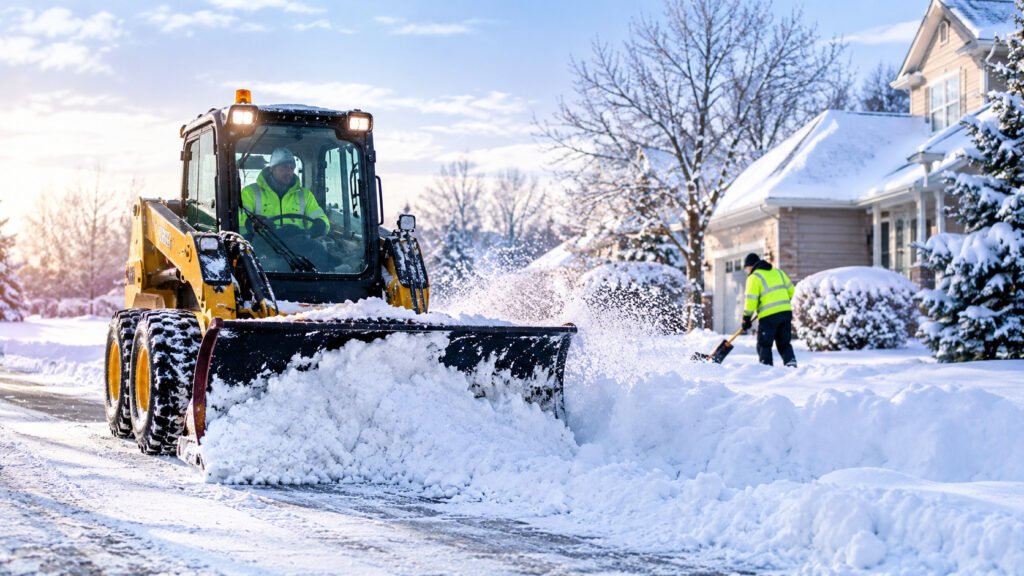
Snow and Ice Management: Professional Services Explained
There’s a difference between a guy with a plow truck and a real snow and ice management operation, and most property owners only learn that difference the hard way, usually after a slip-and-fall claim or a lot that stayed a sheet of ice through three days of foot traffic. Buffalo winters don’t leave much margin for error.
This guide walks through what professional snow and ice management actually involves, so you know what you’re paying for and what to expect.
Quick Answer
Snow and ice management services typically include plowing, salting or brining, sidewalk and walkway clearing, ice control monitoring, and sometimes roof snow removal for flat or low-slope roofs.
A good provider services your property on a set trigger- a certain snowfall depth or ice risk- rather than waiting for a call, and carries liability insurance that protects you if someone gets hurt.
What Falls Under Snow and Ice Management
Snow and ice management is a broader category than plowing alone. It covers everything involved in keeping a property safe and accessible through winter weather, clearing snow from drive lanes and parking areas, treating surfaces before and after storms to prevent ice bonding, clearing sidewalks and entrances, and monitoring conditions as temperatures shift throughout the day.
In Buffalo, where a lake-effect band can dump a foot of snow in a few hours and then clear out just as fast, that monitoring piece matters as much as the plowing itself.
A property that only gets plowed once, after the snow stops, often ends up with refreeze overnight, turning slush into a hazard by morning. Real snow and ice management accounts for that cycle, not just the storm itself.
Snow and Ice Control: The Chemistry Behind It
Ice control isn’t just tossing salt down and hoping for the best. Different products work at different temperatures; standard rock salt loses effectiveness below about 15 to 20 degrees Fahrenheit, which happens often enough in a Buffalo winter that relying on salt alone leaves gaps in coverage.
Calcium chloride and magnesium chloride blends work at lower temperatures and are commonly used when a deep freeze is expected.
Pre-treating with brine before a storm is one of the more useful tools in snow and ice control. Brine creates a barrier that keeps snow from bonding to pavement, which makes the plowing that follows faster and more complete.
It’s a step that doesn’t show up as dramatically as a plow truck clearing a lot, but it makes a real difference in how clean a surface looks after the snow’s been pushed.
Ice Removal Services for Walkways and Entrances
Parking lots get a lot of attention, but ice removal services for sidewalks, entrances, and stairwells matter just as much, if not more, from a liability standpoint. Most slip-and-fall incidents happen in foot-traffic areas, not in the middle of a parking lot.
Hand shoveling, walk-behind blowers, and targeted de-icing product application handle these zones, where a truck or skid steer either can’t reach or would be overkill.
For commercial properties especially, entryways need attention multiple times during a storm, not just once at the end. Snow tracked in and melted by foot traffic can refreeze near doors as temperatures drop in the evening, creating a hazard that wasn’t there a few hours earlier.
Roof Snow Removal Service: When It’s Necessary
Roof snow removal service isn’t something every property needs every winter, but it becomes necessary when accumulated snow load starts to exceed what a roof structure was designed to carry, particularly on flat or low-slope commercial roofs, which are more common on retail, industrial, and multi-unit residential buildings than on typical single-family homes.
Heavy, wet snow weighs considerably more than the light, powdery snow common in colder snaps, so a foot of wet spring-like snow can put more stress on a roof than two feet of dry powder.
Signs a roof might need attention include sagging in the ceiling below, doors and windows that suddenly stick, cracking or popping sounds, and visible ice dams building up at the roof edge.
Roof snow removal is specialized work; it requires understanding load limits and safe removal methods that don’t damage roofing material or create uneven loading during the process. This isn’t a job for a general plow crew; it typically requires a provider with specific experience and the right equipment for the job.
Commercial vs Residential Snow and Ice Management
The scale and expectations differ quite a bit between commercial and residential properties. Commercial ice management usually involves service contracts with defined trigger depths, documented service logs, and sometimes 24/7 monitoring during active storms, since a business open to the public carries real liability exposure if a customer or employee gets hurt on-site.
Residential snow and ice management tends to be more straightforward: driveway and walkway clearing, with salting focused on steps and entry points.
That said, homeowners carry liability too, particularly for sidewalks that run along public right-of-way, where local ordinances in many Buffalo-area municipalities require snow to be cleared within a set timeframe after a storm ends.
Service Triggers and Response Time
One of the most important things to understand about professional snow management is the concept of a service trigger, the snowfall amount or condition that automatically starts a service visit, rather than waiting for a phone call.
Common triggers are set at 1 to 2 inches of accumulation for lots that need to stay clear for business operations, with ice-only triggers set separately for freezing rain events that don’t produce much snow but create serious hazards.
Response time matters just as much as the trigger itself. During a multi-day lake-effect event, a property might need several service visits rather than one, and a provider juggling too many properties for their crew size ends up stretching response times thin exactly when conditions are at their worst.
It’s worth asking a potential provider directly how many properties one crew covers and what their average response time looks like during an active storm, not just on a clear day.
Liability and Insurance Considerations
This is the part that gets overlooked until something goes wrong. Snow and ice management services should carry general liability insurance that covers slip-and-fall incidents connected to their service.
For commercial properties, many providers offer a written service contract that specifies exactly what’s covered, how often the property is serviced, and what documentation is kept. Service logs with timestamps have become a standard expectation for a lot of commercial accounts, since they provide real evidence of what was done and when if a claim is ever filed.
Homeowners should ask about this too. A provider without liability coverage puts the property owner at greater risk if a worker or a visitor is injured during or after a service visit.
Equipment Behind Professional Snow Management
Professional snow and ice management relies on a mix of equipment matched to the property. Plow trucks handle open lots and drive lanes. Skid steers and compact tractors manage tighter areas, curbs, and islands that a full-size truck can’t navigate safely.
Walk-behind blowers and hand tools cover sidewalks and entrances. Spreaders, whether truck-mounted or handheld, apply de-icing product at the right rate; too little doesn’t work, and too much wastes product and can harm nearby grass and landscaping.
The right equipment mix depends entirely on the property’s layout, which is why a property walk-through before the season starts is worth doing rather than assuming a one-size-fits-all approach will work.
What to Ask Before Hiring a Provider
A short conversation upfront can save a property owner real headaches through the season. Worth asking: What’s your service trigger, and how is it monitored? Do you carry liability insurance, and can you provide proof? Do you keep service logs, and are they available if needed? What’s your typical response time during a multi-day storm? And does roof snow removal service fall under your contract, or is that handled separately?
Any established snow and ice management provider should be able to answer these clearly, without hedging.
At Amherst Landscaping, we’ve built our winter operation around exactly these questions, because a property owner shouldn’t have to guess what they’re getting. We run a mixed equipment fleet and set service triggers based on each property’s specific needs, not a generic schedule, since a strip mall lot and a quiet residential driveway don’t need the same approach.
If you’re comparing options for snow and ice management this season or trying to figure out whether your property needs roof snow removal service on top of standard plowing, Amherst Landscaping is happy to walk the property and give a straight answer.
Frequently Asked Questions
What’s the difference between snow removal and snow and ice management?
Snow removal typically refers to plowing alone. Snow and ice management is broader, including ice control, sidewalk clearing, and ongoing monitoring throughout a storm, not just a single plow pass after snowfall stops.
How much snow triggers a professional service visit?
Most commercial contracts set a trigger around 1 to 2 inches of accumulation, with separate ice-only triggers for freezing rain. Residential service triggers vary and are usually agreed upon directly with the homeowner.
Does my property need roof snow removal service?
Flat or low-slope roofs, common on commercial buildings, are more at risk from heavy snow load than typical pitched residential roofs. Watch for ceiling sagging, sticking doors, or cracking sounds as warning signs.
Who is liable if someone slips on my property after a storm?
Liability generally falls on the property owner unless a signed service contract specifies otherwise. Confirming your snow and ice management provider carries liability insurance helps reduce that exposure.
What’s the difference between rock salt and other de-icing products?
Rock salt loses effectiveness below about 15 to 20 degrees Fahrenheit. Calcium chloride and magnesium chloride blends work at lower temperatures, making them more reliable during deep freezes common in Buffalo winters.
Should sidewalks be cleared separately from parking lots?
Yes. Sidewalks and entrances see the most foot traffic and carry higher slip-and-fall risk. Many providers service these areas separately, sometimes multiple times during a single storm, using hand tools or walk-behind equipment.
How do I know if a snow and ice management provider is reliable?
Ask about their service trigger, insurance coverage, service logs, and typical response time during multi-day storms. A provider who answers clearly and specifically is generally a good sign of a well-run operation.
More from the blog
Snow Removal Equipment & Tools: Complete Buyer’s Guide
If you've ever watched a plow truck fly past your commercial lot at 5 AM and wondered what it actually takes to…
Read Article
Lawn Mowing Services in Buffalo NY for a Healthy, Beautiful Lawn
A healthy, well-maintained lawn can transform the appearance of your property, improve curb appeal, and create a more enjoyable outdoor space. For…
Read Article
Snow Removal in Buffalo, NY: Your Complete Local Guide
If you've lived here more than one winter, you already know: Buffalo doesn't do "light dusting." We do lake-effect walls of snow…
Read Article