When to Plant Grass Seed in Amherst, NY
If you have ever stood on your front porch in Amherst, NY, looking at thin patches, lingering weed patches, or a lawn that looks completely exhausted after a humid Western New York summer, you are not alone. A lush, deep-green lawn is the crown jewel of suburban curb appeal across Erie County, but achieving it requires more than just tossing a handful of seeds onto the dirt and hoping for rain.
Knowing when to plant grass seed in Amherst, NY, is the single most important decision you will make for your lawn. Timing determines whether your lawn develops a deep, resilient root network capable of surviving harsh WNY winters or collapses under crabgrass pressure, early frosts, and summer droughts.
Below is a breakdown of exact seeding windows, soil science, grass seed selection, and step-by-step restoration techniques suited specifically for the soil and weather conditions in Amherst.
The Prime Window: Late Summer to Early Fall (Mid-August to Mid-September)
If you ask any seasoned Western New York landscaper for the absolute best time to establish new lawn turf or perform core aeration and overseeding, the answer is unanimous: late summer through early fall, specifically from August 15 through September 20.
Optimal Fall Seeding Window (Amherst, NY)
┌──────────────────────────────────────────────────────────┐
│ AUG 15 SEP 15 OCT 01 │
│ │ │ │ │
│ └──────── Prime ─────────┘ │ │
│ Germination Window Late Seeding Risk │ │
└──────────────────────────────────────────────────────────┘
Why is this mid-August to mid-September timeframe so effective in Amherst? It comes down to a perfect convergence of environmental factors:
- Warm Soil Temperatures: Throughout August and early September, the ground retains solar heat accumulated over the summer. Soil temperatures naturally hover between 55°F and 70°F, which is the absolute sweet spot for germinating cool-season grass species like Kentucky Bluegrass and Perennial Ryegrass.
- Cooler Air Temperatures: While the soil remains warm, daytime air temperatures begin to cool down into the comfortable 60s and 70s. This minimizes thermal stress on delicate young sprouts.
- Diminished Weed Competition: Summer annual weeds like crabgrass, foxtail, and purslane reach the end of their active life cycle in late summer. Tossing seed down in late August means your grass won’t have to fight aggressive summer broadleaves for sunlight and soil nutrients.
- Consistent Dew & Autumn Rains: Western New York autumns traditionally bring increased morning moisture and reliable rainfall patterns. This natural humidity keeps seed beds moist without requiring round-the-clock manual watering.
When you seed during this window, your lawn gets two full growing seasons—fall and the following spring—to build strong, deep roots before facing the grueling summer heat.
Frequently Asked Questions
Q: What happens if I seed in Amherst during late October?
A: Seeding in late October carries a high risk. While seeds may sprout during an unseasonably warm stretch, young shoots rarely develop deep enough root structures to survive hard freezes and frost-heaving typical of Erie County winters.
Q: How long does fall grass seed take to germinate in Western New York?
A: Germination depends on species. Perennial ryegrass can sprout in 5 to 7 days, tall fescue takes 7 to 14 days, and Kentucky bluegrass typically takes 14 to 28 days under consistent moisture.
The Secondary Window: Early Spring Seeding (Mid-April to Mid-May)
Life gets busy, and sometimes the fall seeding window slips by. If your lawn is in desperate shape coming out of snowmelt season, early spring—from mid-April to mid-May—is your second-best window.
However, spring seeding in Amherst comes with distinct challenges that every property owner should understand before buying a bag of seed:
| Feature / Factor | Late Summer / Fall (Primary Window) | Early Spring (Secondary Window) |
| Soil Temperature | Warm (55°F – 70°F) = Fast Germination | Cold (40°F – 50°F) = Slow Germination |
| Weed Competition | Low (summer annuals dying off) | Very High (crabgrass sprouting) |
| Pre-Emergent Herbicides | Can be applied safely in spring | Prevents grass seed from germinating |
| Root Establishment Time | 8–10 months before summer heat | Only 6–8 weeks before July heat waves |
| Watering Requirements | Moderate (natural autumn rain) | High (spring winds & dry June spells) |
If you must plant in the spring, wait until soil temperatures consistently reach at least 50°F. In Amherst, this typically occurs around mid-to-late April after winter snowpack has fully cleared and ground mud begins to settle. Keep in mind that traditional crabgrass preventers cannot be applied over freshly seeded spring lawns unless you use specialized starter fertilizers formulated with sideroxylon or Mesotrione.
Frequently Asked Questions
Q: Can I apply crabgrass preventer if I plant grass seed in the spring?
A: Standard pre-emergents will kill newly germinating grass seed. If you must seed in spring, use a specialized starter fertilizer containing Mesotrione (Tenacity), which stops broadleaves and crabgrass without harming emerging turf seedlings.
Q: Why does spring-seeded grass often die in July?
A: Spring-seeded grass only gets a few weeks to build roots before summer heat sets in. Shallow roots cannot access deeper soil moisture during hot, dry stretches, making the turf prone to drying out without heavy irrigation.
Understanding Amherst Soil & Climate Microclimates
Amherst is unique in its geographic footprint. Extending from the edge of Eggertsville and Snyder up through North Amherst and Getzville, properties across the town face specific soil profiles and weather patterns dictated by proximity to the Niagara River basin and Lake Erie.
Heavy Clay Soil Dynamics
Much of Amherst sits on dense, heavy clay soil. Clay retains nutrients exceptionally well, but it compacts tightly under rain and foot traffic. Compacted soil restricts oxygen movement, traps standing water during wet springs, and hardens like brick during July dry spells.
If you scatter grass seed directly onto un-aerated Amherst clay, the seeds often sit on the surface without establishing proper root depth, leading to spotty, weak germination.
Late Frosts and Lake-Effect Shifts
Because of localized lake-effect influences, springtime soil warm-up in Western New York can fluctuate dramatically. A warm week in late March is often followed by hard April freezes. Sowing seed too early in spring leads to seed rot in soggy, cold earth. This is why soil temperature—not just air temperature—must be your guiding metric.
Frequently Asked Questions
Q: How do I know if my Amherst soil is too compacted for grass seed?
A: Perform a simple screwdriver test. Push a standard 6-inch screwdriver into moist lawn soil. If it meets heavy resistance or cannot penetrate past 1 to 2 inches, your soil is overly compacted and requires core aeration before seeding.
Q: Does proximity to Lake Erie impact when I should plant grass?
A: Yes. Lake-effect weather can hold cold air over the Greater Buffalo area longer in spring, delaying soil warm-up. In fall, however, lake warmth can help delay the first hard frost, giving late-August seeds extra time to establish.
Selecting the Right Grass Types for Amherst Lawns
Because Western New York sits squarely in a cool-season turf region, warm-season grasses like Bermuda or Zoysia will not survive local winters. For a dark green, resilient lawn in Amherst, choose a high-quality blend of the following cool-season varieties:
Amherst Cool-Season Seed Blend Composition
┌──────────────────────────────────────────────────────────┐
│ [ Kentucky Bluegrass ] 40% – Density & Self-Repair │
│ [ Perennial Ryegrass ] 30% – Rapid Germination │
│ [ Fine / Tall Fescue ] 30% – Shade & Drought Hardiness│
└──────────────────────────────────────────────────────────┘
- Kentucky Bluegrass (KBG): The gold standard for Upstate New York lawns. It creates a lush, velvety carpet and spreads via underground stems (rhizomes), allowing it to self-repair bare patches over time. It takes 14 to 28 days to germinate, requiring patience and consistent moisture.
- Perennial Ryegrass: The fastest germinator in the blend, often sprouting in as few as 5 to 7 days. It provides rapid early ground cover, protects the soil from erosion, and offers excellent wear tolerance against kids and pets.
- Turf-Type Tall Fescue & Fine Fescue: Fine fescues excel in shaded properties with heavy tree canopies. Turf-type tall fescues feature deep taproots that dig deep into clay subsoil, providing superior heat and drought tolerance during hot August stretches.
Frequently Asked Questions
Q: What grass seed blend works best for shady yards in Snyder or Williamsville?
A: Shady properties beneath mature oak or maple canopies thrive best on fine fescue blends (creeping red, chewings, or hard fescue). Fine fescues require less direct sunlight and tolerate acidic tree-root zones better than Kentucky bluegrass.
Q: Can I use 100% Kentucky Bluegrass for my lawn?
A: While possible, pure KBG lawns are slower to establish and require high maintenance. A blended mix (KBG, ryegrass, and fescue) offers better disease resistance, faster germination, and adaptable shade/sun tolerance.
Step-by-Step Grass Planting Guide for Amherst Homeowners
Timing is half the equation; proper soil prep and seed-to-soil contact make up the other half. Follow this field-tested restoration procedure to guarantee results:
Step 1: Soil Test & Clean
Step 2: Core Aeration
Step 3: Topdressing
Step 4: Seed & Starter Fertilizer
Step 5: Irrigation Management
Step 1: Soil Testing and Site Preparation
Start by clearing away debris, fallen leaves, sticks, and dead thatch. Test your soil’s pH levels. Ideal lawn soil pH ranges between 6.2 and 7.0. If your soil test shows high acidity—a common issue in wooded parts of Snyder and Williamsville—applying lime will help balance the soil so the new turf can absorb nutrients efficiently.
Step 2: Core Aeration (Crucial for Clay Soil)
Mechanical core aeration removes thousands of small plugs of soil from your lawn. This relieves soil compaction, opens up channels for oxygen and water, and creates thousands of mini-pockets where grass seeds can settle directly against moist earth.
Always water your lawn heavily the night before core aerating, or schedule your aeration 24 hours after a steady Amherst rainfall. Moist clay allows the aerator tines to penetrate 2 to 3 inches deep rather than bouncing off hard, dry soil.
Step 3: Topdress with Quality Compost or Screened Topsoil
Spread a thin layer (1/8 to 1/4 inch) of organic compost or screened topsoil across bare areas. This provides immediate nutrients, enhances water retention, and gives fragile roots an ideal medium to establish.
Step 4: Broadcast Quality Grass Seed & Starter Fertilizer
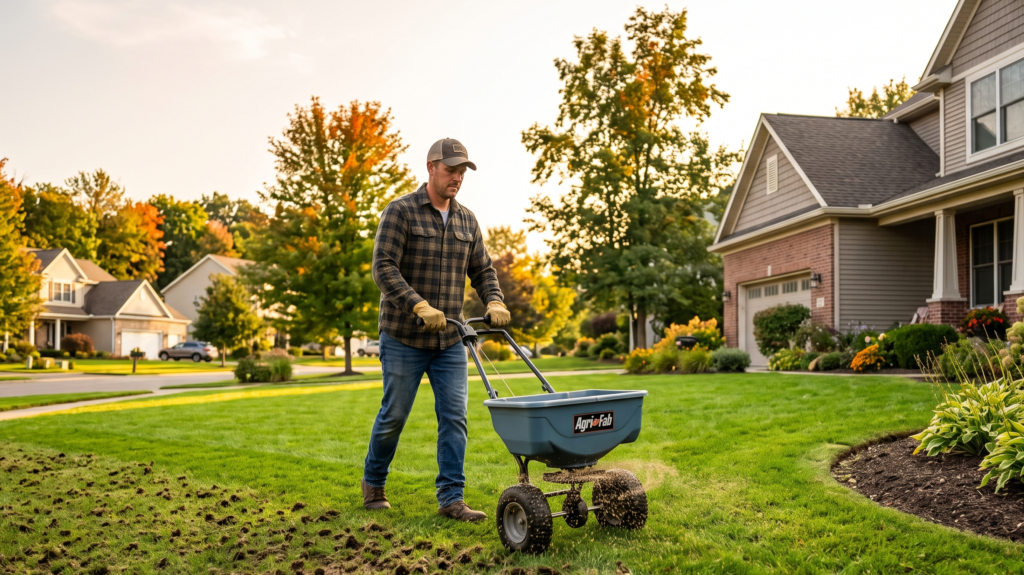
Use a drop or broadcast spreader to distribute your cool-season seed blend evenly. Follow up with a dedicated starter fertilizer high in phosphorus (the middle number on the N-P-K fertilizer label), which fuels rapid root growth during the initial 30 days.
Step 5: Implement a Precise Watering Schedule
Proper watering is where many DIY lawn projects succeed or fail:
- Days 1 to 21 (Germination Phase): Water 2 to 3 times daily for short 10-minute bursts. The goal is to keep the top inch of soil consistently moist like a wrung-out sponge. Never let the seeds dry out once they swell and begin sprouting.
- Weeks 3 to 6 (Establishment Phase): Transition to deeper, less frequent watering—roughly once every 2 days for 25 to 30 minutes. This forces young root systems to grow downward into the soil profile, searching for water.
Frequently Asked Questions
Q: Should I cover my new grass seed with straw?
A: Using clean, weed-free straw or peat moss helps retain moisture and prevents birds from eating seeds on large open slopes. Apply it lightly—you should still see about 50% of the bare soil beneath the straw layer.
Q: How often should I water grass seed after it sprouts?
A: Once seedlings reach 1 inch tall, taper off frequent light sprinklings and switch to deeper, less frequent waterings (2 to 3 times a week). This encourages roots to dig deep into the clay subsoil.
Common Lawn Seeding Mistakes to Avoid in Upstate NY
- Seeding Too Late in Fall (October Onward): While Kentucky Bluegrass can sprout in October, late-planted seeds rarely have enough time to mature before hard freezes hit Erie County. Unestablished seedlings can freeze and die over the winter.
- Using Contractor Mix / Bargain Bags: Inexpensive seed bags sold at big-box stores often contain high percentages of weed seeds, crop seed, and filler species. Invest in certified weed-free blue-tag seed blends designed for northern climates.
- Mowing Too Early: Resist the urge to mow your new lawn until the young grass reaches 3.5 to 4 inches in height. Ensure your mower blades are freshly sharpened so they cut cleanly rather than ripping fragile seedlings out of the soil.
- Applying Weed Killer Too Soon: Never apply standard broadleaf weed sprays on a newly seeded lawn until you have mowed the fresh grass at least 3 to 4 times. Chemical weed killers will stunt or kill tender grass shoots.
Frequently Asked Questions
Q: When can I safely cut my new lawn for the first time?
A: Wait until the new grass shoots reach 3.5 to 4 inches in height. Set your mower deck high (around 3 inches) and ensure mower blades are razor-sharp so they don’t tear young plants out by the roots.
Q: How soon can I treat weeds on my newly overseeded lawn?
A: Avoid selective broadleaf herbicides (like 2,4-D or dicamba) until you have mowed your newly established grass at least 3 to 4 times. Applying herbicide too early will stunt growth or kill fragile seedlings.
Serving Amherst, NY & Surrounding Erie County Communities (Near Me Service Areas)
Whether you are looking for local core aeration, overseeding, or complete lawn restoration, Amherst Landscaping provides expert lawn care services tailored specifically to Western New York soils.
If you are searching for trusted lawn seeding near me or professional landscapers near me in Amherst, we service residential and commercial properties across all local zip codes, including 14221, 14226, 14228, and 14051.
Local Neighborhoods & Communities We Serve:
- Central Amherst & Eggertsville: Heavy clay remediation, yard leveling, and overseeding.
- Snyder & Williamsville Border: Shade-tolerant grass seed blends for mature tree canopies.
- North Amherst & Getzville: Full lawn establishment, hydroseeding, and seasonal fertilization.
- East Amherst & Clarence Border: Large-acreage turf care, core aeration, and dethatching.
Find Amherst Landscaping—Your Local WNY Lawn Care Expert
Transform Your Lawn with Amherst Landscaping
Establishing a thick, weed-resistant, emerald-green lawn requires the right timing, commercial-grade equipment, and a deep understanding of local soil chemistry. If you want to skip the guesswork, heavy machinery rentals, and daily watering hassle, let the local experts at Amherst Landscaping handle it for you.
From full lawn renovations and slice-seeding to professional core aeration, soil conditioning, and custom fertilization programs, we know what it takes to build stunning turf in Western New York.
Ready for a healthier, greener lawn this season?
📞 Call Amherst Landscaping today or request your free lawn evaluation directly on our website!
More from the blog

Snow Removal Equipment & Tools: Complete Buyer’s Guide
If you've ever watched a plow truck fly past your commercial lot at 5 AM and wondered what it actually takes to…
Read Article
Lawn Mowing Services in Buffalo NY for a Healthy, Beautiful Lawn
A healthy, well-maintained lawn can transform the appearance of your property, improve curb appeal, and create a more enjoyable outdoor space. For…
Read Article
Snow Removal in Buffalo, NY: Your Complete Local Guide
If you've lived here more than one winter, you already know: Buffalo doesn't do "light dusting." We do lake-effect walls of snow…
Read Article