
Snow Removal Equipment & Tools: Complete Buyer’s Guide
If you’ve ever watched a plow truck fly past your commercial lot at 5 AM and wondered what it actually takes to keep a property clear all winter, you’re not alone. Buffalo doesn’t do light snow.
Between lake-effect squalls and multi-day accumulation, choosing the right commercial snow removal equipment isn’t just a convenience decision; it’s what keeps parking lots safe, businesses open, and liability off your plate.
This guide walks through the equipment that actually matters, without the sales pitch.
Quick Answer
For most commercial properties in Buffalo, a solid snow removal setup includes a plow truck with a straight or V-plow blade, a skid steer or compact tractor with a plow or pusher attachment for tighter areas, a salt/brine spreader, and hand tools for sidewalks and entryways.
Equipment choice depends on lot size, snowfall volume, and how quickly the property needs to be cleared.
Types of Snow Plows for Commercial Use
Not every snow plow is built for every job, and this is where a lot of property managers overspend or underbuy. Straight blade plows are the standard workhorse, good for open lots, straightforward pushing, and lower upfront cost.
V-plows can split, angle, or scoop, giving more flexibility for tight corners and drifted snow, which matters a lot during a Buffalo lake-effect event when snow piles up unevenly.
Then there’s the box plow, sometimes called a pusher, which is better suited to skid steers and loaders. It’s designed to carry large volumes of snow across open pavement without spilling to the sides, which makes it efficient for big commercial lots where speed matters.
Choosing between these usually comes down to lot layout more than anything else; tight, obstacle-heavy lots favor V-plows, while wide-open lots favor box pushers.
Skid Steers and Compact Tractors
For properties with curbs, islands, tight turns, or pedestrian areas, a full-size plow truck just doesn’t have the maneuverability needed. That’s where skid steers and compact tractors come in. They’re smaller, more agile, and can be fitted with a range of attachments, plow blades, pushers, even snow blowers for heavier accumulation.
A lot of commercial properties in the Buffalo area actually run a combination: plow trucks for the main lot, and a skid steer for sidewalks, loading docks, and areas too tight for a truck to navigate safely. It’s not about picking one or the other; it’s about matching the machine to the space.
Snow Blowers and Their Commercial Applications
When snow piles get too deep to push, blowers become necessary. Commercial-grade snow blowers, whether walk-behind for sidewalks or attachment-style for skid steers and tractors, throw snow well clear of the cleared area instead of just relocating it a few feet over.
This matters in Buffalo especially, where repeated storms can bury a lot in accumulated pushed snow within a single week if it isn’t actually removed or relocated.
Walk-behind commercial blowers are typically used for sidewalks, ramps, and entryways where a vehicle can’t or shouldn’t go. They’re slower than vehicle-mounted equipment but essential for the pedestrian-safety side of a snow removal plan.
Salt Spreaders and De-Icing Equipment
Plowing clears the bulk of the snow, but ice management is its own separate job, and it’s arguably the bigger liability concern. Tailgate spreaders, mounted on the back of a truck, are common for larger lots. For sidewalks and smaller areas, handheld or walk-behind spreaders do the job without overspreading product into grass or landscaping.
Brine application has become more common in commercial snow removal technology over the past several years; pre-treating a lot before a storm hits reduces how much snow bonds to the pavement, which makes the actual plowing faster and more effective.
It’s a step a lot of smaller operations skip, but it makes a noticeable difference in how clean a lot looks after plowing.
Hand Tools Still Matter
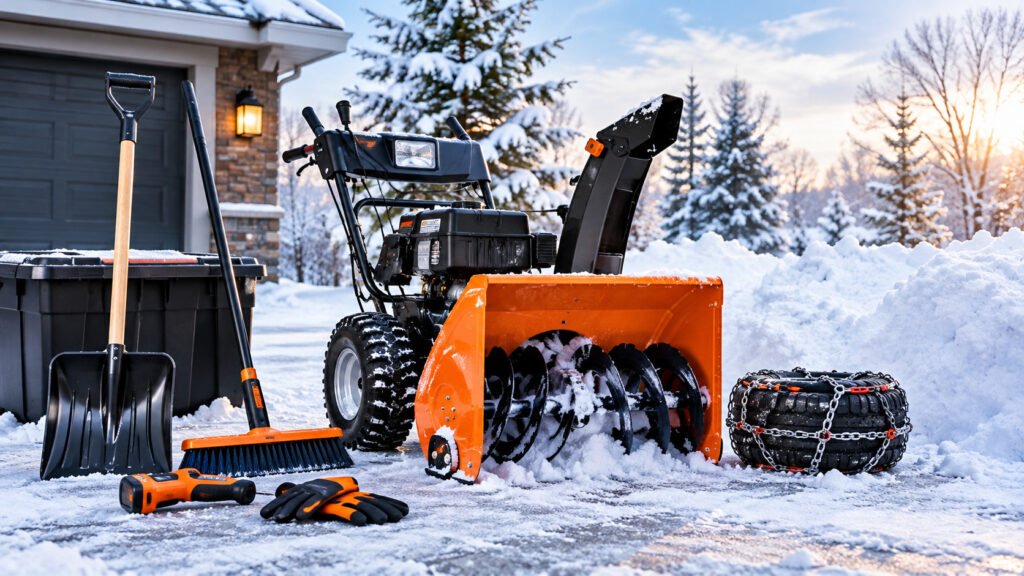
When someone asks for snow removal equipment types, it’s easy to focus entirely on machinery, but hand tools remain essential for a complete snow removal setup. Ergonomic shovels, ice scrapers, and push brooms handle the spots equipment can’t reach: building entrances, stairwells, and tight walkways between structures.
A property that only invests in big equipment but skips hand tools for detail work usually ends up with icy entryways that create real slip-and-fall risk.
GPS and Fleet Tracking Technology
Commercial snow removal technology has shifted quite a bit over the past decade, and GPS tracking is one of the more useful additions. For property managers overseeing multiple sites, GPS-equipped plow trucks let a company verify exactly when a lot was serviced, which matters both for scheduling and for documentation if a slip-and-fall claim ever comes up.
Timestamped service records have become a standard expectation for a lot of commercial contracts, not just a nice-to-have.
Choosing the Best Snow Removal Equipment for Your Property
The best snow removal equipment for one property might be completely wrong for another. A small strip mall with a tight lot and limited turning radius needs different gear than a sprawling industrial site with acres of open pavement.
Questions worth asking before choosing equipment: how large is the area, how many entry points and pedestrian zones need separate attention, how quickly does the lot need to be cleared after a storm starts, and what’s the budget for both equipment and ongoing maintenance.
For most mid-sized commercial properties around Buffalo, a mixed fleet- truck plows for open areas, skid steers for tight spots, and dedicated ice management equipment- covers the range of conditions a typical winter throws at a property.
Maintenance and Equipment Longevity
Snow removal machinery takes a beating every winter, and skipping maintenance is one of the fastest ways to end up with a truck down mid-storm. Blade edges wear down and need replacing, hydraulic systems need regular fluid checks, and spreaders need cleaning after use since salt corrodes metal components quickly if left sitting.
A pre-season inspection catches most problems before they become a 3 AM breakdown during an active storm.
Buying vs Contracting Snow Removal Services
Some property owners buy their own equipment; others contract it out entirely. Buying makes sense for larger properties with consistent, predictable snow removal needs and the staff to operate and maintain equipment.
For smaller properties, or ones without in-house maintenance capability, contracting with a snow removal service often works out cheaper once you factor in equipment cost, storage, repairs, and labor to operate it.
There’s also a liability piece worth mentioning here. If snow removal is handled in-house, the property owner typically carries full liability for any slip-and-fall incidents. Contracted snow removal services usually carry their own liability insurance, which can shift some of that risk off the property owner, though this depends entirely on what’s spelled out in the service contract, so it’s worth reading that section carefully rather than assuming coverage exists.
At Amherst Landscaping, we run a mixed equipment fleet for exactly this reason; no single machine handles every property well, and Buffalo winters don’t leave much room for equipment that can’t keep up.
We’ve serviced commercial lots through enough lake-effect events to know which setups actually hold up under repeated, heavy snowfall versus which ones look good on paper but struggle in practice.
If you’re weighing whether to invest in your own commercial snow removal equipment or hand the job to a contractor, Amherst Landscaping can walk through your property’s specific layout and give you a straight answer either way.
Frequently Asked Questions
What’s the difference between a straight blade and a V-plow?
A straight blade pushes snow directly forward and works well on open lots. A V-plow can angle or scoop, giving more control in tight spaces or uneven drifts, which is common during lake-effect snowfall.
Do small commercial properties need a skid steer?
Not always. Smaller lots with simple layouts may only need a truck plow. Properties with curbs, islands, or pedestrian areas benefit from a skid steer’s tighter maneuverability for detail work.
How often should snow removal equipment be serviced?
A pre-season inspection is recommended annually, plus regular checks on blade edges, hydraulic fluid, and spreader components throughout the season. Salt exposure corrodes metal parts quickly if not cleaned after use.
Is brine treatment worth it for commercial lots?
Yes, for many properties. Pre-treating pavement before a storm reduces snow bonding, making plowing faster and more effective. It’s an added step, but it noticeably improves post-storm lot conditions.
Who is liable for slip-and-fall injuries on a commercial lot?
Liability typically falls on the property owner unless a signed contract with a snow removal company specifies otherwise. Always review contract language carefully to confirm what liability coverage the service actually includes.
Should I buy equipment or hire a snow removal service?
It depends on property size and in-house maintenance capability. Larger properties with consistent needs may benefit from owning equipment. Smaller properties often find contracting more cost-effective once maintenance and labor are factored in.
What equipment is best for sidewalks and entryways?
Walk-behind snow blowers, ergonomic shovels, and handheld salt spreaders handle areas vehicles and larger machinery can’t reach. These tools are essential for reducing slip-and-fall risk at building entrances and stairwells.
More from the blog
Lawn Mowing Services in Buffalo NY for a Healthy, Beautiful Lawn
A healthy, well-maintained lawn can transform the appearance of your property, improve curb appeal, and create a more enjoyable outdoor space. For…
Read Article
Snow Removal in Buffalo, NY: Your Complete Local Guide
If you've lived here more than one winter, you already know: Buffalo doesn't do "light dusting." We do lake-effect walls of snow…
Read Article
Residential Snow Removal: Best Practices & Local Services
There's a specific kind of tired that comes from shoveling a driveway at 6 a.m. before work, only to look outside at…
Read Article