
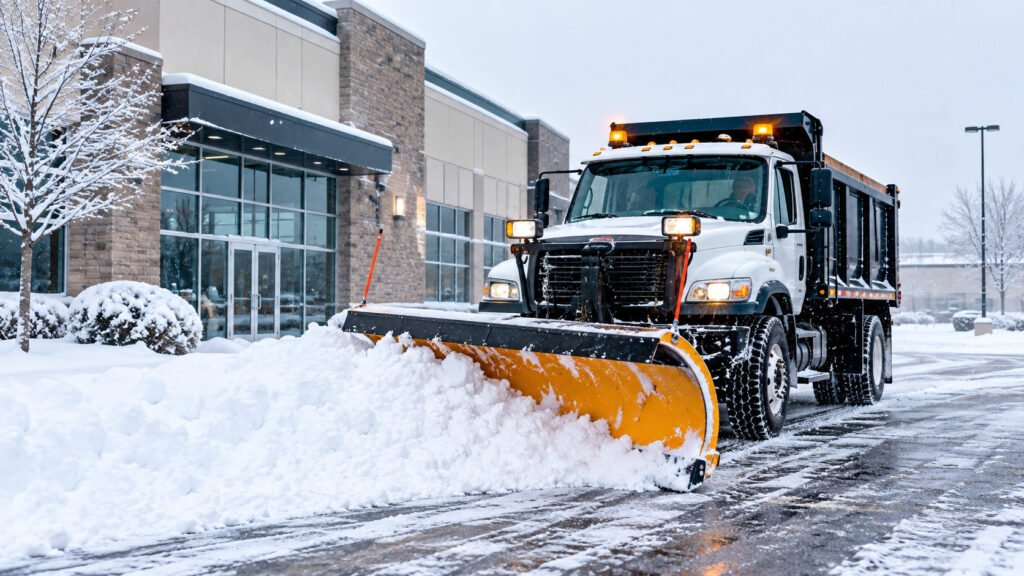
Commercial Snow Removal: Services, Pricing & Contracts
Running a business in Buffalo means winter isn’t a seasonal inconvenience: it’s a line item you plan for the same way you plan for rent or payroll.
A parking lot that isn’t cleared by 6 a.m. isn’t just an eyesore; it’s a liability risk, a lost customer, and potentially a reason an employee can’t make it in safely. Commercial snow removal isn’t optional here, and treating it as an afterthought tends to cost more than treating it as a real operational decision.
This guide breaks down what commercial snow removal actually involves, how pricing typically works, and what to look for in a contract before you sign one. We’ve handled enough commercial lots through enough Buffalo winters to know where property managers usually get surprised, and it’s rarely the weather itself.
Quick Answer
Commercial snow removal covers parking lots, sidewalks, loading docks, and fire lanes, typically priced by seasonal contract, per-push visit, or per-inch pricing depending on lot size and storm frequency.
Expect contracts to specify trigger depth, response time, and liability terms. Most commercial properties in the Buffalo area budget between $2,000 and $15,000+ per season depending on square footage and service level.
What Commercial Snow Removal Services Actually Include
People sometimes picture commercial snow removal as a bigger version of residential plowing, and in some ways that’s true, but the scope usually runs wider.
A full-service commercial snow removal operation typically handles parking lot plowing, sidewalk and entrance clearing, ice management with salt or brine application, snow hauling or relocation when piles get too large for the lot, and sometimes roof snow load monitoring for flat-roof commercial buildings after major storms.
Fire lane clearance deserves its own mention because keeping emergency access clear can be a safety and compliance requirement depending on the property and local rules.
Blocked fire lanes can mean fines from the municipality and a real safety risk if emergency access is needed. A property manager working with commercial snow removal companies should confirm this is explicitly covered, not assumed.
ADA-compliant clearing matters too: entrances, ramps, and designated accessible parking spots need to be cleared to a standard that keeps them usable, not just technically passable. This is one of those details that gets overlooked until an inspection or a complaint brings it up.
Why Commercial Properties Can’t Treat This Like a Residential Job
The stakes are different for a business than for a single driveway. A slip-and-fall in a commercial parking lot can turn into a real liability claim, and A slip-and-fall can also create liability concerns, which is why many commercial property owners keep records of plowing, salting, inspections, and other winter maintenance activities..
That’s part of why serious commercial snow removal services keep service logs: time-stamped records of when a lot was plowed, salted, or inspected. If something happens, that documentation matters.
There’s also the operational side. A retail store that can’t open because the lot isn’t cleared loses a day’s revenue. A medical office with patients arriving for appointments has different urgency than an office building where employees can occasionally work from home during a storm.
Response time expectations should match how the property actually gets used, which is a conversation worth having before a contract gets signed, not after the first storm exposes a gap.
How Commercial Snow Removal Pricing Typically Works
Commercial snow removal pricing isn’t one-size-fits-all, and understanding the structure helps avoid surprises mid-season.
Seasonal contracts offer a flat rate for the whole winter, regardless of how many storms hit. This gives predictable budgeting, which a lot of property managers prefer, but it means paying roughly the same amount in a light snow year as a heavy one.
Per-push pricing charges for each visit, triggered once snowfall hits a certain depth, commonly 2 inches for commercial lots, though this is negotiable. This can save money in a mild winter but gets expensive fast during a heavy one.
Per-inch pricing scales cost to actual snowfall totals, which some property owners find fairer, though it requires trusting accurate measurement and reporting.
Beyond the base structure, a few factors move commercial snow removal pricing up or down: total square footage of the lot, number of entrances and sidewalks, how many separate visits a storm might require, salt and ice management add-ons, and how quickly response is guaranteed.
Snow storage and hauling can also affect the final price, especially when a property has limited space for piling snow and requires removal from the site.
A large retail plaza with multiple entrances and a tight response window will cost more per season than a small office lot with flexible timing; that’s just the physics of how many labor hours and equipment passes it takes.
It’s worth asking for an itemized quote rather than a single bundled number. Knowing what’s covered under the base price versus billed as an extra keeps both sides honest once the snow actually starts falling.
What Belongs in a Snow Removal Service Contract
This is the part that gets skimmed too quickly, and it shouldn’t be. A solid snow removal service contract should spell out:
- Trigger depth: exactly how many inches of accumulation initiates a plow visit
- Response time: how many hours after snowfall stops (or during, for ongoing storms) service begins
- Scope of coverage: lot, sidewalks, dumpster areas, fire lanes, loading docks, all specified individually
- Ice management terms, whether salting or brining is included or billed separately, and under what conditions it’s applied
- Liability and insurance, proof of coverage, and language addressing responsibility if the property is damaged during service
- Cancellation and renewal terms, what happens if either party wants to end the agreement mid-season
- Communication protocol, who to call during a storm, and expected response time for questions or issues
Vague contracts cause more disputes than bad weather does. If a contract says “regular service” without defining trigger depth or response window, that’s a conversation worth having before signing, not after the first missed storm.
Choosing Among Commercial Snow Removal Companies
Not every operator that plows residential driveways is equipped to handle commercial-scale work, and the difference matters.
Commercial lots need larger equipment, more staff coverage per storm, and often overnight or early-morning crews to have a lot cleared before a business opens. When evaluating commercial snow removal companies, a few things are worth checking directly:
Ask how many commercial properties a crew typically services in a single storm event, and what happens if a storm runs longer than expected. A company juggling too many properties with too few trucks tends to fall behind exactly when reliability matters most.
Ask about equipment redundancy: what’s the backup plan if a primary plow truck breaks down mid-storm? This is a bigger deal commercially than residentially, since a delayed commercial lot affects more people at once.
Ask for references from other commercial clients, ideally ones with similar property types. A company that’s mainly done small residential routes may not have the crew size or equipment for a large retail lot or multi-building complex.
Amherst Landscaping has managed commercial accounts across the Buffalo area long enough to know that the operations that hold up under pressure are the ones with real depth, backup equipment, enough staff to cover multiple properties simultaneously, and a dispatch system that doesn’t fall apart during a 12-hour lake-effect event.
Snow and Ice Management as a Year-Round Relationship
The strongest commercial arrangements aren’t purely reactive. Good snow and ice management services often include a pre-season walkthrough of the property to flag drainage issues, identify where snow piles will realistically go without blocking access, and confirm salt application points ahead of the first storm rather than figuring it out in real time.
That kind of preparation makes storm-day service much more predictable because crews already know where snow can go, which areas need extra attention, and who to contact when conditions change..
Red Flags Worth Watching For
A few things worth pausing on before signing with any commercial snow removal provider: no written contract or vague verbal terms, no proof of commercial liability insurance, reluctance to specify trigger depth or response time in writing, and no clear answer about backup equipment or staffing during major storms.
None of these alone is disqualifying, but together they suggest a company that may not be built for commercial-scale reliability.
Final Thoughts
Commercial snow removal is one of those services that’s easy to underestimate until a bad storm exposes the gaps in an existing plan. A clear contract, realistic pricing structure, and a company with the equipment and staffing to deliver during a serious storm matter more than simply choosing the lowest quote in October.
Amherst Landscaping has been part of enough of these conversations with Buffalo-area property managers to know that the properties that handle winter best are the ones that treated the planning seriously before the first snowfall, not after.
Frequently Asked Questions
How much does commercial snow removal typically cost per season?
It varies widely based on lot size and service level, but most Buffalo-area commercial properties budget somewhere between $2,000 and $15,000 or more per season. Larger lots with tighter response requirements cost more.
What’s the difference between per-push and seasonal contract pricing?
Per-push pricing charges for each individual visit triggered by snowfall, while seasonal contracts offer one flat rate regardless of storm frequency. Seasonal contracts offer predictability; per-push can save money in a light winter.
Is sidewalk and entrance clearing included in commercial snow removal?
Not always automatically; it depends on the contract. Many providers price sidewalks, entrances, and ADA-compliant pathways separately from lot plowing, so confirm this explicitly before any agreement.
What trigger depth is standard for commercial properties?
Two inches is common, but it’s negotiable and should be specified clearly in the contract. Properties with heavy foot traffic sometimes negotiate a lower trigger depth for earlier response.
Do commercial snow removal companies handle ice management too?
Most full-service providers offer salting or brine application as part of snow and ice management services, though it may be billed separately. Confirm whether it’s included or an add-on before signing.
What happens if a snow removal company misses a storm?
This should be addressed directly in the contract, including any penalties or service credits for missed response windows. Ask specifically how missed or delayed service is handled before agreeing to terms.
How far in advance should I sign a commercial snow removal contract?
Most reliable companies fill their commercial routes by early fall. Waiting until the first snowfall often means limited provider availability or being added to a waitlist for that season.
More from the blog
Snow Plowing Services Near Me: What to Know Before Hiring
Amherst winters don't wait for anyone. One day you're raking the last of the leaves, and the next you're staring at eight…
Read Article
Complete Guide to Snow Removal Near You: Options & Services
Amherst gets real winters. Lake-effect snow can turn an ordinary driveway into a serious clearing job overnight. If you've lived here long…
Read Article
Core Aeration vs. Dethatching for Amherst Yards
When reviving a struggling Western New York lawn, deciding between core aeration and dethatching is one of the most critical maintenance choices…
Read Article