Amherst Town Codes for Landscape Construction: Your Local Permitting Guide
Navigating the local regulations for modifying your outdoor space can feel like trying to read a blueprint in the dark. If you are planning an outdoor upgrade in our neck of the woods, understanding Amherst Town Codes for Landscape Construction is the single most important step before any shovel hits the dirt.
Whether you want to build a classic New England fieldstone retaining wall, install a private backyard fence, or completely reshape your property’s grading, your project must align with local bylaws. Failing to secure the right permits or violating zoning ordinances can lead to costly retrofits, project delays, or structural adjustments down the road.
As local landscape construction specialists serving the Amherst community, we have compiled this comprehensive guide to help you design a beautiful, legally compliant landscape that respects both town guidelines and our unique local environment.
1. Do You Need a Permit? Common Landscape Projects
Not every weekend garden refresh requires a trip to Town Hall. However, structural modifications, hardscaping, and large-scale clearing almost always do. Under Amherst Town Codes for Landscape Construction, projects are carefully categorised based on their impact on safety, neighborhood aesthetics, and environmental ecosystems.
Here is a quick breakdown of common residential projects and their general permitting requirements:
| Landscape Project | Permit Required? | Governing Authority / Special Conditions |
| Fences & Garden Walls | Yes (Building Permit) | Compliance with height limits and setbacks is mandatory. |
| Retaining Walls (under 4 feet) | No (Usually) | Exempt if they do not alter structural grading or sit near property lines. |
| Retaining Walls (over 4 feet) | Yes (Building Permit) | Requires certified structural engineering plans. |
| Patios & Walkways | No / Conditional | Exempt unless they violate maximum lot coverage ratios. |
| Tree Removal (Mature/Shade) | Yes (Tree Warden) | Public shade trees and large historical trees require formal approval. |
| Work near Wetlands/Streams | Yes (Conservation) | Any work within a 100-foot buffer zone requires strict review. |
Frequently Asked Questions
Q: Can I install a simple backyard patio without notifying the town?
A: In most cases, yes. Standard paver or stone patios laid directly on grade do not require a building permit. However, if the patio significantly alters your property’s total impervious surface area (surfaces that don’t absorb water), you must verify that you are not violating the town’s maximum lot coverage limitations.
Q: What happens if I start a landscape construction project without a required permit?
A: If a project is discovered without proper documentation, the town can issue a visual “Stop Work” order. You may face fines, double permit fees, or be forced to dismantle completed hardscaping if it is later found to violate zoning setbacks or building codes.
2. Structural Standards: Fences, Walls, and Setbacks
Fences and retaining walls are excellent for establishing privacy and managing sloped yards, but they are also the most common sources of code violations and neighborhood disputes.
Fence Height and Material Restrictions
Amherst town ordinances strictly regulate where you can place a fence and how high it can be.
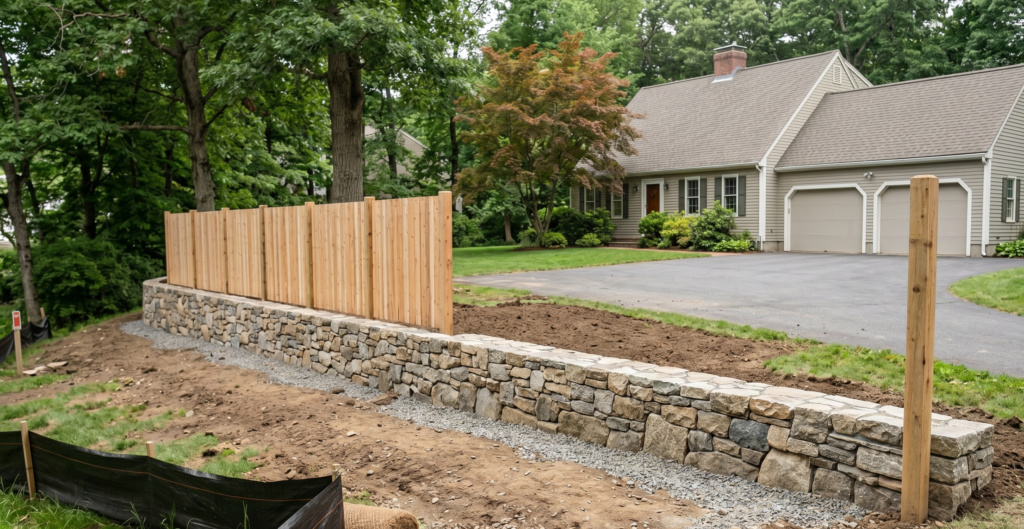
- Front Yards and Street Yards: To preserve open streetscapes and ensure driver visibility at intersections, fences, hedges, or garden walls in the front yard cannot exceed 3.5 feet in height and must be semi-opaque.
- Side and Rear Yards: For traditional privacy screens in your back or side yards, you can build up to 6 feet in height relative to the natural ground level.
- Prohibited Materials: To maintain regional visual character, certain materials like chain-link, plastic, barbed wire, and razor wire are heavily restricted or outright prohibited on residential lots. Homeowners are encouraged to use timeless materials like naturally weather-resistant wood, stone, brick, wrought iron, or dark aluminium.
Retaining Walls and Grading Changes
Because Amherst features a mix of rolling terrain and sensitive clay soils, altering the slope of your yard can drastically change how rainwater flows. If you are building a retaining wall over 4 feet tall, you must submit structural engineering calculations with your building permit application. Additionally, town codes state that your landscape construction cannot divert excess stormwater runoff directly onto a neighbor’s property or into public roadways.
Frequently Asked Questions
Q: Do I need my neighbor’s permission to build a fence on my property line?
A: While formal permission isn’t legally required if the fence sits entirely within your boundary lines, it is highly recommended. Amherst codes require fences to be placed within your property limits unless a shared boundary agreement is officially filed. Additionally, the “good side” (finished face) of the fence must face outward toward neighboring properties or the street.
Q: How is the height of a retaining wall measured?
A: Retaining wall height is measured from the very bottom of the first structural block or footing underground to the top of the wall cap. If a wall measures 4 feet or more across that total vertical distance, it transitions out of basic landscape work and requires an engineered plan.
3. Preservation and Environmental Protection Rules
Amherst values its rich natural heritage, agricultural history, and old-growth tree canopy. Because of this, landscape construction is bound by stringent environmental preservation laws.
The Public Shade Tree Act & Scenic Roads
If your property abuts a public road or sits within one of Amherst’s designated scenic roads, you cannot simply cut down mature trees near the property line. Under Massachusetts General Law and local bylaws, public shade trees are protected.
- Removing or heavily pruning a public shade tree requires a public hearing and explicit permission from the Amherst Tree Warden.
- Violating these tree protection acts carries a minimum fine of $500 per violation or legal penalties.
- Additionally, if your property sits within one of the town’s National Historic Register Districts, removing any tree with a diameter of 18 inches or greater requires a consultation with the Historical Commission.
Wetland Buffer Zones and Conservation
Is there a stream, pond, wet meadow, or certified vernal pool near your backyard? If so, the Amherst Conservation Commission regulates all activity within a 100-foot buffer zone of any wetland resource area.
Before clearing brush, dumping fill, or pouring a concrete patio footprint, you must file either a Request for Determination of Applicability (RDA) or a formal Notice of Intent (NOI). Working within these zones without a protective erosion barrier can halt your project instantly.
Frequently Asked Questions
Q: How do I know if a tree on my property edge is considered a “public shade tree”?
A: Any tree growing within or directly abutting the public right-of-way (the strip of land closest to the street, which often extends several feet past the actual asphalt) is protected. If you are unsure where your property line ends and the town’s right-of-way begins, a professional surveyor or a quick call to the tree warden can clarify ownership.
Q: Can I plant whatever I want inside a wetland buffer zone?
A: Not necessarily. While adding native plants is generally encouraged, the Conservation Commission must approve the plan to ensure no heavy machinery disrupts the soil matrix and that no invasive species are introduced to the delicate ecosystem.
4. Step-by-Step Permit and Project Planning Process
To keep your project moving forward smoothly, it helps to approach the planning and permitting steps in the proper order.
1. Review the GIS Plot Plan: Pre-Planning.
Pull your property’s plot plan from the Amherst online GIS database. Check your property lines and existing structural footprints, and look for any noted wetland overlays, historic zones, or utility easements.
2. Draft the Landscape Design: Design Phase.
Create a clear site plan showing the exact dimensions, heights, and material selections for your proposed patios, fences, or retaining walls. Calculate your total lot coverage to ensure compliance with zoning ratios.
3. Consult with Town Departments: Pre-Application.
Visit the Office of Conservation and Development at Town Hall. Present your preliminary sketch to inspection services and the conservation department to confirm exactly which permits your project requires.
4. Submit Applications & Secure Permits: Approval Phase.
File your formal building or conservation permits online. Wait for approvals and post the physical permit cards clearly on your property before moving any heavy machinery or construction equipment onto the site.
Frequently Asked Questions
Q: How long does the typical landscape building permit application take to get approved?
A: Straightforward building permits for basic fences or walls typically take between 10 to 14 business days. However, if your design requires a review by the Conservation Commission or the Historical Commission, the public hearing schedule can extend the timeline by 4 to 6 weeks.
Q: Where can I find my home’s official property boundaries for the permit layout?
A: You can access basic property layouts using the Amherst Online GIS mapping tool. For precise structural installations close to a boundary edge, hiring a local licensed land surveyor is the safest way to prevent future encroachment disputes.
Looking for Certified Landscape Construction Near Me?
When tackling extensive residential transformations, search engine queries for premium hardscaping, drainage modifications, or patio installations often bring up countless options. However, executing a layout that effortlessly balances structural beauty with strict compliance requires deep familiarity with our unique regional micro-districts.
Our dedicated landscape crew proudly operates throughout the entire municipality, ensuring proximity, speed, and structural precision for every neighborhood. If you are searching for dependable, code-compliant landscape construction near me, our service footprint includes the following:
- North Amherst / Cushman: Managing rural setbacks, extensive grading challenges, and historic farmstead protections.
- South Amherst: Navigating clay-heavy grading limits, residential privacy setbacks, and agricultural perimeter zoning rules.
- East Amherst: Custom backyard living designs, pool surrounds, and patio expansions conforming to strict lot-coverage ratios.
- Downtown / University Border Areas: High-density zoning optimisations, strict property line fencing, and high-visibility front street yard guidelines.
Our Local Service Profile & Interactive Map
To view our primary office location, check out our standard operational service radius, or quickly get precise point-to-point driving directions for a face-to-face planning consultation, explore our official verified interactive local map profile below.
Frequently Asked Questions
Q: Do you service neighborhoods immediately bordering Amherst?
A: Yes. While our primary focus centres on staying up-to-date with Amherst municipal ordinances, our active service range naturally encompasses local property owners seeking hardscape installations and land planning across adjacent towns.
Q: Can your team handle the entire physical permit submittal process on my behalf?
A: Absolutely. Part of true professional execution means managing the structural design drafting, scheduling a professional site assessment, filing the documentation with inspection services, and coordinating on-site structural inspections so you never have to guess about code compliance.
Why Professional Compliance Matters for Your Property
Designing a beautiful yard is only half the battle; ensuring it stands the test of time legally and structurally is the other. Hiring a licensed, fully insured local landscape contractor ensures that your project uses regionally appropriate materials, incorporates proper deep-frost footings, and aligns perfectly with all Amherst Town Codes for Landscape Construction.
By following local ordinances, preserving our native tree canopy, and implementing proper stormwater management, you protect your home’s long-term resale value while helping keep Amherst a green, sustainable, and beautiful place to live.
More from the blog

Snow and Ice Management: Professional Services Explained
There's a difference between a guy with a plow truck and a real snow and ice management operation, and most property owners…
Read Article
Snow Removal Equipment & Tools: Complete Buyer’s Guide
If you've ever watched a plow truck fly past your commercial lot at 5 AM and wondered what it actually takes to…
Read Article
Lawn Mowing Services in Buffalo NY for a Healthy, Beautiful Lawn
A healthy, well-maintained lawn can transform the appearance of your property, improve curb appeal, and create a more enjoyable outdoor space. For…
Read Article